
Reclaiming democracy in Hungary — Interview with Eva Bordos
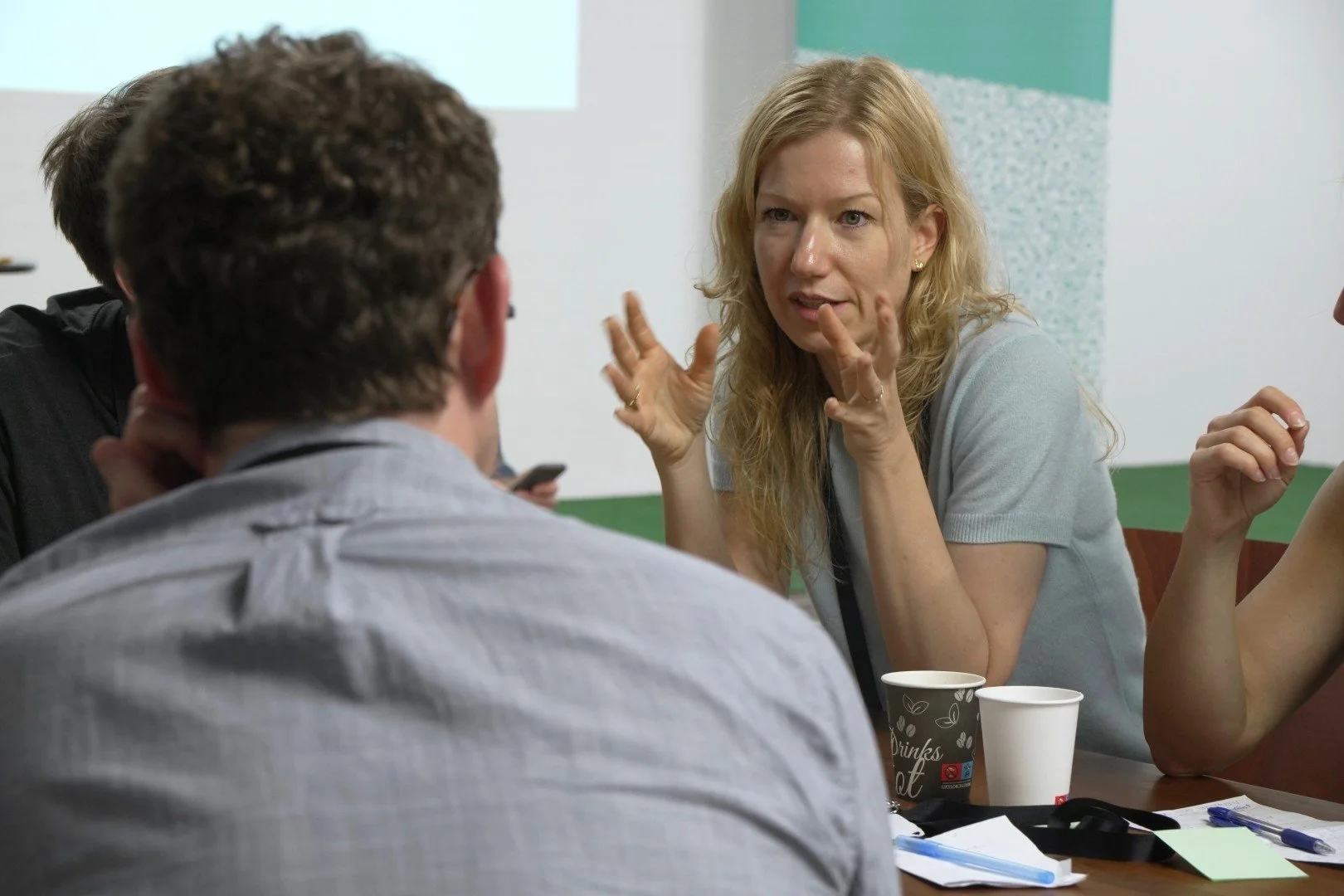
‘Once the right forum is provided, citizens are ready to solve the biggest challenges of their community’
DemNet is a long standing NGO in Hungary and Eva is no stranger to participants from previous Deliberative schools where she has presented inclusion and information provision through the cases of local deliberation in Hungary. Her professional journey has seen her contribute to renowned institutions, including the OSCE, UNICEF, and the Regional Environmental Center for Central and Eastern Europe (REC). She is also a member of FIDE’s Executive board. Together with her team, she has been a frontrunner in the implementation of participatory and deliberative practices in Hungary.
In this interview, we delve into the Hungarian deliberative context through DemNet’s main projects. Specifically, we gain insights from the Miskolc Citizen’ Assembly on Air quality, the Budapest Climate Assembly and Érd’s Assembly on the city’s green transition.
For detailed information on these cases, visit: demnet.hu/en/reports
Quesion: DemNet has a long standing history as an NGO in Hungary, and you work on sustainability and human rights. But a few years back, you shifted your focus to deliberative democracy and citizens’ assemblies. Why did you make that shift?
Eva Bordos: We have a long track record. DemNet was established back in 1996, and the primary aim of the organization was to promote cross-sectoral dialogue, facilitate civic engagement, and fight social and economic inequality. Our goal was to strengthen civil society, not only in Hungary but also in the wider region. We are part of the wider Central and Eastern European scene and the European Union, so partnering with regional actors and projects has always been part of our core activities.
Over the years, we realized that traditional forms of consultation were no longer effective in Hungary due to the shrinking space that civil society occupies within the country, the growing apathy of citizens, their increasing distrust of democratic institutions and each other.
It became very clear that we needed to reinvent and reclaim democracy somehow. That realization happened in line with the growing deliberative democracy movement, the Deliberative Wave. So, we immediately connected with partners here in Hungary and beyond.
Democratic culture in Hungary is often portrayed in an early stage, where active citizenship and civic participation are outliers. One may think that this would impact negatively on the willingness of citizens to participate. However, what do your groundwork and research tell us?
E.B.: The decades of Soviet influence left their mark, and citizens often see public affairs as something that it's better to stay out of. So, we were initially wondering, ‘Will citizens sign up for these processes? Is there an appetite for these tools?’. We were amazed to see that the answer to these questions was yes. Our recent research confirms that citizens, especially at the local level, do want to influence decisions affecting their lives. For example, the registration rate for our assemblies is no lower than that in other, more established democracies.
But I do not want to paint an idealistic picture. There are indeed challenges. For instance, convincing municipalities and decision-makers to try these methods is difficult. It requires a new mindset that takes time to acquire. Change will not happen overnight.
Another political development, not unique to Hungary, is that civil society space and space for consultation is shrinking. For example, in May, the Hungarian Government adopted a law that allows local municipalities to hold public hearings without the physical presence of citizens. The government is essentially trying to empty these spaces out. At the same time, there are some politicians who argue that the way forward is more direct contact with citizens. They understand that democratic innovations benefit them, too.
From your experience and the number of cases run in Europe, it’s clear that the local level is at the forefront of this transformation. At the same time, they often face difficulties to have access to the resources that enable good quality processes. What advice would you give to municipal and regional officials with limited resources to safeguard the legitimacy and quality of the process? Where should their priorities be?
E.B.: Smaller-scale assemblies can work well at the local level. What is important, however, especially in a fragile democracy or in a challenging context, is not to compromise on quality. Deliberative democracy” and “citizen participation” have become very popular buzzwords but weak processes, and those that are not followed upon properly, in the long run, could undermine the whole concept. They would do more harm than good because citizens would become even more disappointed with the system. I fear that we will be seeing more so-called civic washing in the future.
So, the big question is: how do we ensure that these processes hold up to quality standards? We need to have these debates in the deliberative democracy community, and we do not have to be afraid of also addressing some very tough issues. We need to come to a common understanding of the elements that we cannot make compromises on.
In the Hungarian context or other contested situations, ensuring that level of quality and legitimacy may present additional challenges. How do you achieve it in so-called ‘illiberal democracies’ or polarized contexts?
E.B.: One of the most important aspects is that these processes need to be independent. We often talk about political buy-in, which I agree is essential. But we also need to make sure that political buy-in does not become a political takeover. Citizens need to see these processes as independent, non-partisan processes that are for everybody, regardless of their background and who they vote for.
Therefore, communication is essential to ensure awareness beyond specific electorates and parts of society. Local media coverage makes a big difference. There are also other effective techniques during the registration period for reaching citizens.
In the case of the local assembly that took place in Érd - which is a small but rapidly growing city near Budapest – in the months prior to the event, we attended public events together with public officials to distribute leaflets and answer questions about the process. There were also posters at bus stops and medical centers. That really helped spread the word and have citizens understand what was going on. We also had a hotline in place to answer citizens’ questions directly via phone and were also very active on social media.
The one in Miskolc -the fourth largest city in Hungary- was the second local assembly we organized. What we saw there was that these small things really made an impact. We conducted a public survey after the assembly, and it turned out that 47% of the Miskolc residents had heard about the Citizens’ Assembly. That is an amazing number! We would have never thought that we could reach this many people.
Another crucial element is to work with local NGOs. They can really help you with outreach and communication. Now, we are organizing a citizens’ assembly this spring in one of Budapest's districts where we plan to do door-to-door recruitment. After the invitation letters are sent out, we will visit randomly selected households to try to convince their members to sign up. We are curious to see what kind of results that will bring.
A key part of the credibility and legitimacy for the future of these processes is their follow-up, the translation of citizens’ recommendations into policy. What do the Hungarian cases teach us about the complexity of this phase?
E.B.: The Budapest Citizen’s Assembly’s recommendations made it into the climate strategy of the city that was adopted three months after the Citizens’ Assembly had taken place. Most of the recommendations made it into the strategy unchanged. We were very happy about that.
However, even if these recommendations become part of a strategy the concept is just one thing. The bigger question is how these recommendations are implemented later. On that front, there is room for improvement. We understand that municipalities face challenges and some of the recommendations are quite costly and we understand the limitations. But I think it is still important to track what happens to the recommendations and have politicians communicate about them.
In the case of Miskolc, we were super happy because after the assembly concluded and had submitted its recommendations, the municipality invited assembly members to work with them on the long run to help implement the recommendations as so-called climate ambassadors. 16 out of the 50 assembly members volunteered. Nine of them have actually been very actively working together with the municipality over the past one and a half years. They took on various roles, went to schools and talked to students about the process and the recommendations. The municipality also published a quite detailed report one year after the Assembly. They detailed where they stand with the implementation of the various recommendations.
Moreover, three months after the Assembly, the municipality adopted a participatory strategy in which they also discussed and outlined various forms of citizen participation and consultation. The Citizens’ Assembly experience was instrumental to achieving this. Citizens’ Assemblies feature in the strategy and it is stated that the municipality is committed to making them as one of its key tools for developing policies together with citizens.
Out of all these processes, what main lessons can you draw and how do you see the wider deliberative space evolving in Hungary?
E.B.: Deliberative processes need to be more widespread. The experience so far is that once the right forum is provided, citizens are no longer afraid of wisely contributing to solving the biggest challenges of the community. This is quite promising.
Notably, in all processes that we have run, the dropout rate has been extremely low. This means that once citizens start the process and they are committed, they become really willing to dedicate time and energy to find joint solutions to common challenges. The feedback we have received so far is also overwhelmingly positive. Of course, there's skepticism about what will happen to the recommendations, but there is also hope. So, we need more processes at the local level.
Democratic innovations have to make it into the broader and more general public discourse, too, because, despite all the efforts, these processes are still new to the whole region. Very few people know about them.
In Hungary, we have lots of societal traumas and challenges that are not present in the public discourse. I think that deliberation can help us not only understand each other better but also deal with these societal traumas. Citizens’ assemblies are a good way forward in this process.
After three participations in our deliberative schools, why do you want to bring the Spring School to Budapest?
E.B.: Civic activism regarding the climate crisis has been gaining momentum in Central and Eastern Europe in recent years, as citizens become increasingly aware of the environmental challenges their communities face. Within this societal push, Climate Citizens' Assemblies can play a crucial role in decision makers and citizens working together and advancing public dialogue in an informed, inclusive and effective way. We need these to, for example, tear down that smog curtain that still separates Eastern Europe from Western Europe.
Citizens’ assemblies can also serve as a catalyst in renewing democracy in the region. Holding the School in Central and Eastern Europe for the first time is also symbolic. There are certainly challenges in this part of the world, but we don't want to give up on democracy, and neither should others give up on us.
And while one of the aims of the School is to build more capacities in the region, the School is certainly not only for Central and Eastern Europeans. In my experience, FIDE’s schools are excellent opportunities to share ideas, learn from each other and also to understand each other's contexts. I hope no less for this year’s Spring School!