

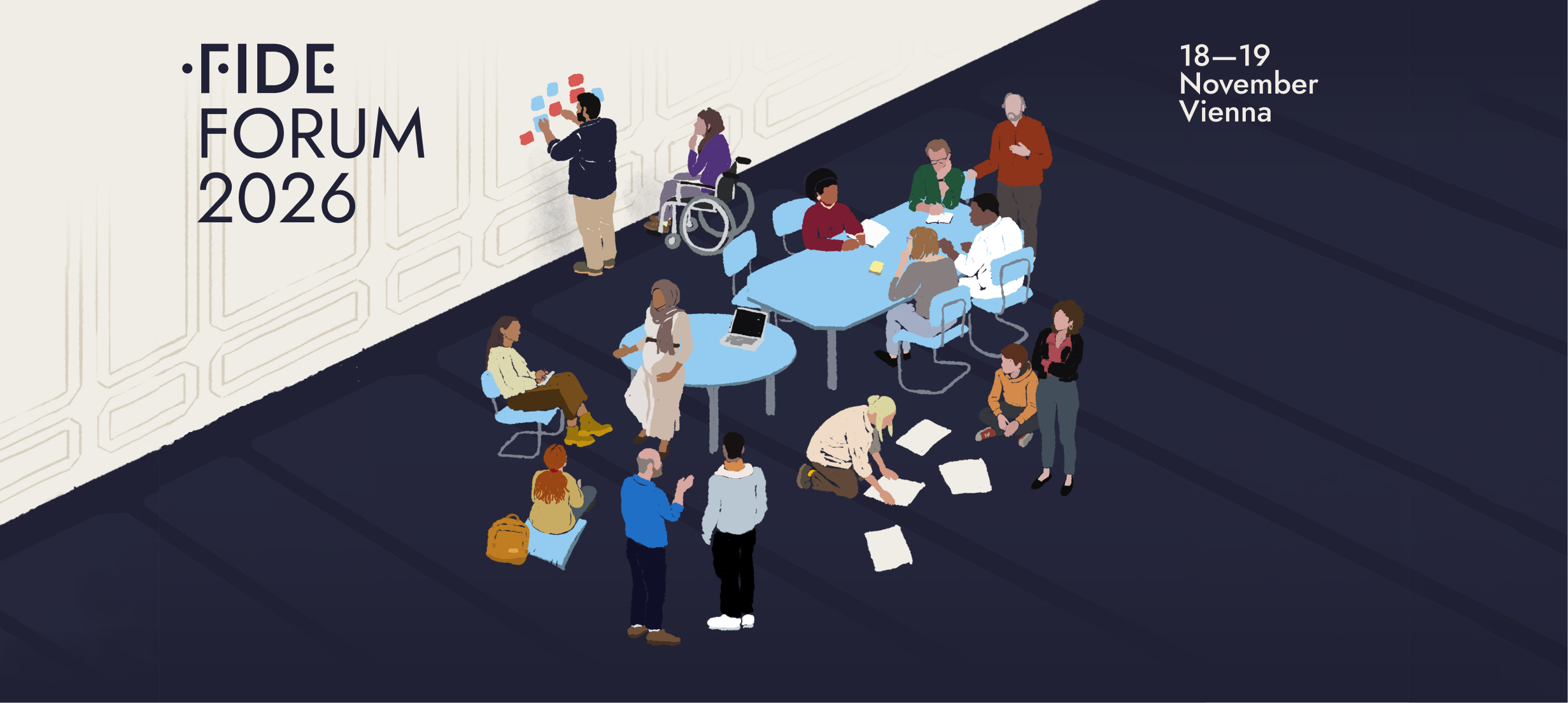
Where deliberative practice meets.
A conference for practitioners, public officials, political parties, NGOs, and funders to move this field from the margins to the mainstream.
To build the infrastructure, lift the standards, and create the political will to make it permanent.
Deliberation as democratic infrastructure
Democracy runs on public infrastructure. Independent judiciaries, electoral systems, public education: these are not optional features. They are the foundations the whole system rests on. When they erode, the model erodes with them.
Deliberation belongs in the same category. More than 1,000 deliberative processes have been run around the world. More than 80,000 citizens have contributed to decisions on constitutional reform, national legislation, and public spending. The evidence is there. What is missing is the commitment to treat this as infrastructure, not experiment.
Designing policy without citizen participation is like laying foundations without soil tests. You might move faster at first. Long-term stability comes from understanding the ground you are building on.
FIDE Forum 2026 is a space to do the work that makes deliberation last.
FIDE Forum 2026 interactive program. It appears on the published page.
Full program
Tuesday 17 November 2026
Built to last
Politicians on democratic investment
We invest in roads, in grids, in defense, and in courts because we know what they cost us when they fail. Democratic infrastructure is no different. Electoral integrity, the rule of law, media freedom, and an active civic life are the foundations on which everything else depends, including the policies citizens are asked to accept. Citizens' Assemblies are part of how mature democracies maintain that infrastructure between elections.
This opening session brings together elected representatives to share what deliberation has been worth in their own political work, and what democracies risk when they treat the foundations as optional.
In partnership with Bertelsmann Stiftung. Free and open to everyone. Separate registration required, including for Forum participants.
- Lotte Stoops, First Vice-President, Member of the Parliament of the Brussels-Capital Region
- Leonore Gewessler, Former Federal Minister for Climate Action, Environment, Energy, Mobility, Innovation and Technology of the Republic of Austria
- Ana Aguirre Uriz, Director of Open Government, Basque Country
- Gábor Kerpel-Fronius, Municipal Advisor, Budapest Metropolitan Municipality, Mayor's Office
- Jürgen Czernohorszky, Executive City Councillor for Climate, Environment, Democracy and Personnel of the City of Vienna
- Yves Dejaeghere, Executive Director, FIDE Europe
Wednesday 18 November 2026
Million moments for democracy
The story of a citizen movement that became permanent
Every country has its moment of catharsis. For the Czech Republic, the spark was lit on November 17, 2017, culminating in hundreds of thousands of citizens standing together in Prague's Letná Park in the largest public gatherings since the 1989 Velvet Revolution. They were demanding political accountability and the defense of democratic institutions. It was the emergence of Million Moments for Democracy. But what happens when the crowd goes home?
Mikuláš Minář shares the story of how to build a grassroots movement that outlasts the initial spark. He argues the key lies in every one of us: in the small, generous contributions we make when we volunteer in our neighborhood or simply refuse to look away when democratic norms are tested. Democracy is a never-ending effort to involve everyone in the decisions that affect their lives.
Almost a decade later, this civic-led initiative remains a permanent democratic force—capable of collecting 60,000 signatures in just a few hours and mobilizing 250,000 citizens to the streets. In this keynote, we explore how to channel the raw energy of historic protests into a resilient, everyday practice of active citizenship.
- Mikuláš Minář, Czech civic activist and co-founder of the Million Moments for Democracy movement.
Structured networking
11:00 — 11:30 · Break
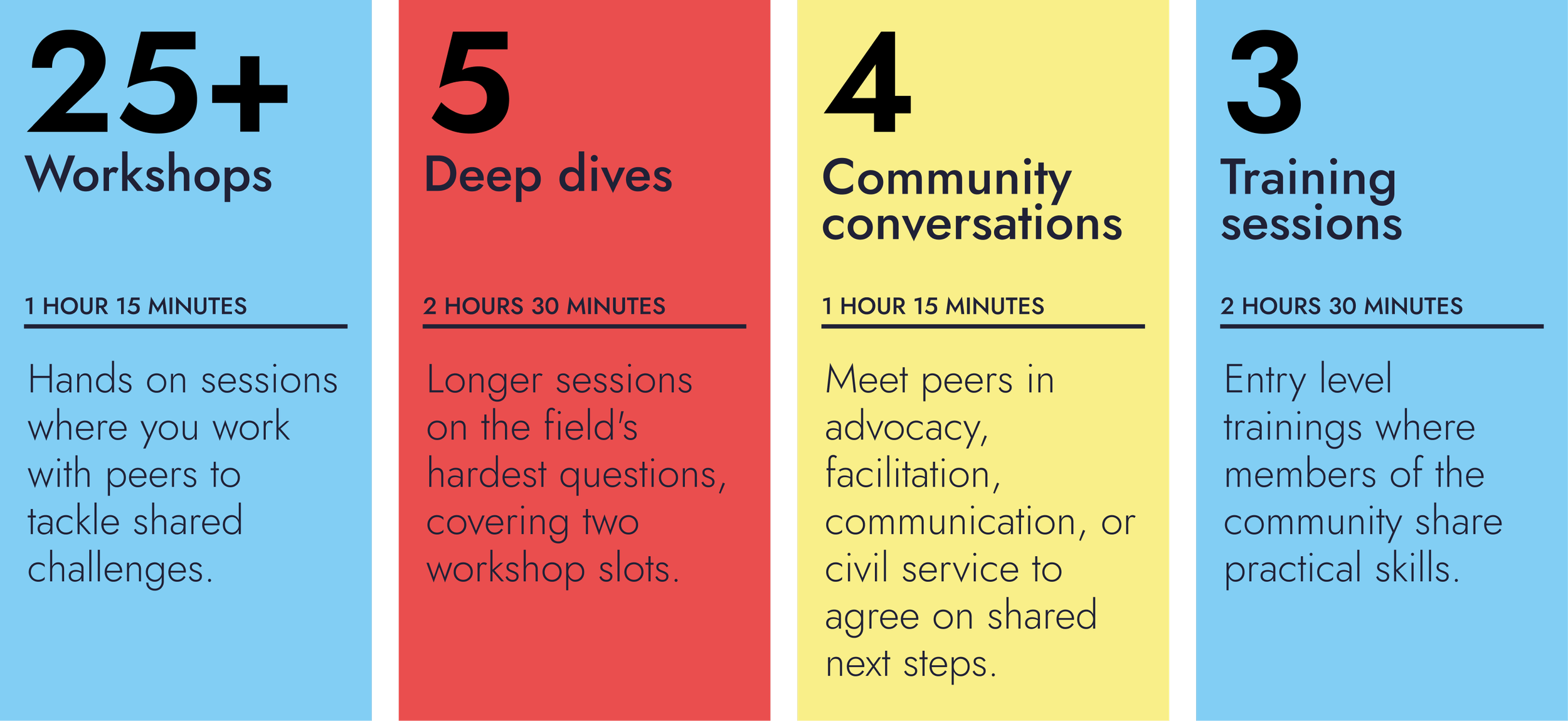
Workshops 1: Work time
Challenging polarization before it defines your deliberative process!
Affective polarization—the emotional hostility between groups—undermines democratic culture and collaborative problem-solving. This workshop aims to equip participants with practical knowledge of a scientifically validated depolarization methodology that they can adapt and apply in their own professional contexts. At the same time, we aim to collaboratively explore how these tools can be refined and further developed for use in deliberative settings, particularly in highly polarized environments and specifically in the context of civic councils.
- Sarah Maria Ventura Foki, Project Manager, Initiative Offene Gesellschaft
Supporting citizens beyond their assembly
Why it matters and potential models
Participation in a Citizens’ Assembly is a transformative experience, activating citizenship and igniting a deep sense of civic responsibility, but what happens next without infrastructure to sustain that engagement? The Impact Amplifiers Network (IAN) was created by FIDE North America to address this often-overlooked gap, connecting alumni of assemblies across the United States and Canada. Launching in October, IAN brings together members from roughly a dozen assemblies, with the network continuing to grow. The platform was shaped directly by the experiences and priorities of nearly 70 past assembly participants, and provides resources to help them continue their civic journeys. This workshop will explore the need for meaningful post-assembly support and share lessons from the development of IAN. Participants will consider how these lessons can be incorporated into their own assembly design and practice.
- Marjan Ehsassi, Executive Director, FIDE North America
Designing multi-method participation for complex policy decisions
How can different participation methods be combined into a coherent process that meaningfully supports decision-making? This interactive workshop draws on Finland’s ongoing Future of Work-Based Immigration project to explore the design of multi-method participation processes. The project combines national dialogues, large-scale online participation and a citizens’ assembly as part of a single participation process. Using a real-world case, facilitated group work and peer reflection, participants will examine how different participation methods can contribute to a broader process, discuss key design choices and trade-offs, and explore how participation processes can better support decision-making in complex and contested policy areas.
- Hannu-Pekka Ikäheimo, Director, Democratic Innovations Programme, Finnish Innovation Fund Sitra
- Heikki Lauha, Specialist, Democratic Innovations Programme, Finnish Innovation Fund Sitra
Sector by sector
Are we missing a trick when it comes to embedding change?
Founded in 2023, Citizens In Power has already achieved significant impact. In just three years, it has grown a national network that in turn has played a major role in securing national policy and local institutional change - all focussed on embedding citizen led decision-making.
Keys to its success include: its arts sector setting; its founders (senior arts-sector figures); its exclusive focus on infrastructure building.
Yet despite its achievements, its sector-based approach remains unusual. So are we missing a trick? And if sector-based approaches can be so effective, what does that mean for how we work?
This workshop seeks to explore and build on the lessons from Citizens in Power’s approach.
- David Jubb, Co-director, Citizens in Power
- Lucy Reid, Chief Strategy and Creative Officer, DemocracyNext
- Saad Eddine Said, Co-director, Citizens in Power
- Sarah Allan, Freelance deliberative engagement specialist, Freelance
Participatory decision-making
Bringing citizens into the democratic process
The meaningful integration of participatory practices into political decision-making processes requires systematic change. This workshop proposes an integrative approach, embedding participation into existing decision-making pathways, e.g. in initiating or drafting new laws. Workshop participants will learn how to identify promising sites and timeframes for integrating participation into existing political decision-making pathways, and how to adapt the participatory process itself to ensure functionality and impact in the respective contexts. We also aim to gather participants' knowledge on the topic and initiate collaboration on the output that follow this workshop.
The guiding questions for this workshop are:
1) What are the goals of integration and what indicates success?
2) Where and when should we integrate participation?
3) How do we design for integration?
- Felix Petersen, researcher and lecturer in political sciences, University of Münster
- Florian Wieczorek, Head of Mini-Publics and Public Participation, Mehr Demokrati e.V.
Beyond democratic lotteries
Building the next generation of recruitment and selection for citizens' assemblies and other deliberative events
Citizens' assemblies rely on public trust, yet organisers face low response rates, unequal participation, mistrust, limited budgets, and growing expectations for inclusion and transparency. This workshop brings practitioners together to identify key recruitment and selection challenges, explore trade-offs, and develop practical, shared recommendations to strengthen citizen recruitment and advance deliberative democracy.
- Bea Sándor, Co-Head of the EU Democratic Lottery Network, Sortition Europe
Where we are and where we need to go in evaluating citizens’ assemblies
As citizens’ assemblies (CAs) become more widely adopted, rigorous and independent
evaluations are becoming increasingly necessary. This workshop draws on FIDE North America’s Learning Series to explore how to evaluate CAs. Participants will learn about the value, limitations, and challenges of conducting independent evaluations. Together we will discuss how evaluations can heighten the credibility of evaluation findings, and deepen our understanding of CA outcomes and processes.
- Lindsay McMahon, Evaluation Fellow, FIDE North America
Deep dives: Buckle up
Intergenerational fairness
Involving children and young people in democratic innovations
There is significant growing interest across the world about how citizens’ assemblies, and other democratic innovations, can support children and young people to participate in decisions affecting their lives and futures. What does intergenerational deliberation truly look like, and what key design principles and methods need to be considered to ensure the representation of current, younger generations and of future generations? This deep dive will be an opportunity to bring together young people, practitioners, researchers, advocates to shape the future of intergenerational deliberation.
This Deep Dive will be led by young citizens’ assembly alumni members from Ireland and Switzerland who are behind Assemble Now!, a global programme for young alumni of citizens’ assemblies aged 12-25, supported by Child Rights International Network (CRIN) and Pro Futuris Think + Do Tank.
- Che Wagner, Pro Futuris Think + Do Tank
- Katie Reid, Child Rights International Network (CRIN)
Beyond the expert lecture
How citizens' assemblies learn – a deep dive learning journey
Learning is the heart of every citizens' assembly. Participants explore their own views, listen to each other and engage with experts and people affected. Only then can they deliberate and decide well. But designing this learning is demanding, and two challenges stand out. First, what knowledge do citizens really need, how much is enough, and who decides? The question of balance, trust and facts becomes harder in polarised times. Second, how is knowledge conveyed? People learn in very different ways, so the choice of formats shapes what participants can actually take in and use. Both challenges belong together: what we select and how we convey it determine whether citizens trust the process and will develop impactful recommendations. In this interactive deep dive, we make the session itself a shared and fun learning journey, pooling experiences and practices from the room.
- Eva Mackevica, head of participation department, Field of Dialogue Foundation (Fundacja Pole Dialogu)
- Jacob Birkenhäger, Deliberative Expert and Lead Facilitator
12:45 — 14:00 · Lunch
Workshops 2: Work time
One-hit-wonder?
Identifying and overcoming hurdles to sustain deliberation in politics and administration
Within this workshop we not only want to win an overview of different hurdles that inhibit democratic innovations. We also want to learn how to overcome them. Therefore, we combine perspectives from administration, politics, and practice. Daniel Oppold from the “Servicestelle Bürgerbeteiligung Baden-Württemberg” will give insights on how an administrative innovation is boosting the use of deliberative democracy. Juliane Baruck and Hannah Rüdiger from Hallo Bundestag will share two scenarios of institutionalising their “Constituency Day” format. Together, we will share insights about why real-life politics and ideas of democratic innovations do not naturally match, and what to do about it.
Let’s exchange approaches for how deliberative formats can be embedded into political and administrative structures, so that they can scale!
- Hannah Rüdiger, Advocacy „Hallo Bundestag“ at Demokratie Innovation e.V.
- Daniel Oppold, Advisor at the Agency for Citizen Participation Baden-Wuerttemberg, political scientist and workshop facilitator
- Juliane Baruck, Strategic Lead “Hallo Bundestag“ at Demokratie Innovation e.V., facilitator, political scientist, Lead “Hallo Bundestag”
Transparency
Definitions and standards for citizens’ assemblies: from principle to practice
Transparency is widely recognised as essential for the legitimacy of citizens’ assemblies, yet there is little agreement on what standards should be applied in practice. This workshop will define the concept of transparency and examine it across the full lifecycle of a citizens’ assembly, identify key dilemmas and trade-offs. The goal of the workshop will be to collaboratively develop the first draft of a Transparency Checklist for practitioners, researchers and commissioning institutions.
- Eva Bordos, Executive Director, DemNet
- Marjan Ehsassi, Executive Director, FIDE North America
- Damir Kapidzic, University of Sarajevo
Stress-testing a European civic tech hub
From participation needs to democratic infrastructure
Europe needs meaningful digital participation as trust in institutions declines and political debate is increasingly shaped by platforms and AI. Yet civic tech for digital engagement remains fragmented: providers struggle to scale, administrations face a “spider web” of tools and regulation, and citizens rarely see the effect of their input. Bertelsmann Stiftung and Sitra are collaborating to support the creation of a European Civic Tech Hub to elevate digital citizen participation. Drawing on interviews, roundtables and research into civic technology and participation in the age of AI, as well as lessons from the European Voxit Community, the workshop will explore what civic-tech infrastructure Europe needs to support participation and deliberation. Participants will examine priority functions of the hub: from community-building, peer learning and tool mapping to procurement, interoperability, and responsible AI. We will assess how the hub could serve civic tech providers, open-source communities, public administrations, participation practitioners, and citizens. The discussion will directly inform the work of Sitra and Bertelsmann Stiftung with the European Commission and EU stakeholders.
- Sanna-Kaisa Saloranta, Specialist, Democracy Team, Sitra International Programmes
- Stefan Roch, Project Manager, Bertelsmann Stiftung
Tough clients, good lessons
Field notes on safeguarding assemblies from those who commission them
Citizens' Assemblies are becoming popular, even fashionable. As a result, more are commissioned by clients and sponsors who are new to the process and who may misunderstand it, change it or weaken it. MASS LBP has run more than 60 assemblies over 18 years, advised others on their design and implementation and worked with many different clients and sponsors. One of its Senior Directors opens the session with real cases: what went wrong and what worked.
Participants will map the safeguards used at each stage, from procurement and scoping to delivery, reporting and adoption. We will build an inventory of common problems and a practical menu of tactics for protecting an assembly's integrity.
This is an advanced session for practitioners experienced in the governance, design and delivery of sortition processes and Citizens' Assemblies.
- Chris Ellis, Senior Director, MASS LBP
Designing for what emerges
A process designed for citizens or shaped by citizens?
To what extent are deliberative processes open to transformation in response to citizens’ contributions? When design predetermines the topics, dynamics or boundaries of discussion, citizens can become participants in a largely top-down process. This workshop explores how facilitation can create space for genuinely bottom-up deliberation, where emerging perspectives, difficult conversations, minority voices and unexpected themes can inform the process itself. Rather than offering a fixed model or “right” answers, we invite participants to explore how facilitation can help processes remain inclusive, responsive and grounded in human rights while preserving complexity, disagreement and meaningful citizen agency. Through an exploratory format, we will question whether we are designing processes for citizens or creating conditions for citizens to shape the process themselves.
- Anna Sanne Göransson, Engagement Strategist, Digidemlab
- Carmen Nieto Cornellá, Independent researcher & collaborator at Deliberativa, Facilitator and Qualitative Researcher
What happened to the "representative stage" of citizens' assemblies?
The first citizens' assemblies of the 2000s included what we call a “representative stage”: after being selected, assembly members were expected to engage with citizens beyond the minipublic, seeking their views on the issues they had been called to consider and represent. As citizens' assemblies evolved during the second and third decades of this century, however, this representative stage largely disappeared from both practice and definitions.
This workshop will ask: Why did the representative stage disappear? What have we lost by leaving it out? And, most importantly for practitioners, how could we bring it back? Rather than proposing a single model, we want to open a practical design conversation about new ways in which assembly members can connect with, listen to and represent the wider citizenry.
- Felipe Rey, Co-director, iDeemos
- Indira Latorre, Co-director, iDeemos
15:15 — 15:45 · Break
Community building: Join a conversation
Advocacy
For movement builders and strategists working to advance the deliberative agenda in political and public spheres. This track focuses on building cross-sector alliances, securing political buy-in, and coordinating advocacy and fundraising strategies.
Facilitation
The deliberative field has expanded rapidly over the past decade, yet facilitation remains a critical challenge. Standards differ widely, the connection between design and practice is often fragile, toolboxes tend to be highly individual and implicit and the network and cooperation between deliberative facilitators is not strong. As part of the Deliberative Facilitation Training program, we are creating a community of deliberative facilitators to elevate the field through exchange, documentation, and training. In partnership with We Do Democracy.
In partnership with We Do Democracy.
Communication
For communicators, campaign designers, and messaging strategists working across Citizens' Assemblies and organizational outreach. A space to test messaging strategies, explore collaborations, and build the relationships that can support your next campaign.
Civil servants
This session is the bi-annual meeting of the Network for Citizen Participation & Deliberation in Europe, co-founded by Bertelsmann Stiftung and FIDE. The network is a multi-level coalition of representatives from European, national, and regional institutions with regular or embedded deliberative practices. We welcome civil servants who are not part of the network. Civil servants only.
In partnership with Bertelsmann Stiftung. Civil servants only.
17:00 — 17:15 · Moving to plenary
Wrapping up
19:00 — 22:00 · Official dinner
Thursday 19 November 2026
Standards: what makes a deliberative process good?
A field-wide deliberation on the risks and opportunities of our practice
As a community of practice, we keep circling the "standards" question: how many days, what kind of outputs, how to stratify. It's a hard conversation. That is why at FIDE, we have a living document with definitions and guidelines for Citizens' Assemblies.
Good processes have to be adapted to their context, so few are truly alike, and we often expect different things from them: some want detailed policy recommendations that weigh up trade-offs, others are okay with a high-level vision, others think that choice belongs to participants entirely. Until we're clear on what "good" means, arguments about the process design features are really arguments about different goals. What we want are context-sensitive standards.
Standards are worth the effort. They help commissioners tell a strong process from a weak one, give practitioners something to point to when pressured to cut corners and give the field a shared basis for building evidence about what works. This session won't set standards. It will give us better tools for getting there. In small groups, we'll:
- Name what success looks like and where our definitions diverge
- Play saboteur
- Propose what we'd ideally measure to know whether a process actually worked.
The results (points of agreement, disagreement, and measurement ideas) will inform a revision of our own definitions and guidelines document, and support a research program run by the AI & Democracy Foundation, which is working towards evidence-based answers.
- Simone Klint, Senior Consultent and Head of Organisation, We Do Democracy
- Kyle Redman, newDemocracy Foundation / AI & Democracy Foundation
11:15 — 11:45 · Break
Workshops 3: Time to work
How do we measure the impact of democratic participation?
A model and a tool for strategising and evaluation
Democratic Impact is a model designed to measure the value of participation – both in deliberative processes and in other forms of participation within democracy. The model forms the basis for a strategy and evaluation tool that can measure the effects, changes, outcomes and circumstances that arise within each area in connection with a participatory activity, process or format. By measuring in 10 areas of impact and 33 dimensions, the model aims to help strengthen our understanding and knowledge of the value created by different forms of democratic participation. The strategic tool is for planning purpose and focus for a particiaption proces, and create a clear vision across the organisation(s). The evaluation tool is to analyse and highlight what change is happinging in the individual and the system dure to the process.
- Simone Klint, Senior Consultent and Head of Organisation, We Do Democracy
- Zakia Elvang, Executive Director, We Do Democracy
From innovation to integrity
How can a label ensure credible deliberative democracy?
Across Europe, public authorities are increasingly experimenting with new forms of democratic practice such as citizens assemblies. Yet inconsistent approaches to deliberative democratic processes can undermine legitimacy and fuel mistrust. This workshop invites practitioners to help shape a Council of Europe benchmarking mechanism, identifying key standards and safeguards to ensure high-quality, credible deliberative processes and to help distinguish meaningful participation from tokenism.
- Natalia Militello, Project Co-ordinator, Council of Europe
- Rowena K Merritt, Consultant, Council of Europe
From organic deliberation to democratic infrastructure
Exploring long-term options
Serbia’s citizen and student plenums offer a remarkable live case of deliberation emerging from below — and a starting point for imagining more durable models of public decision-making. Born in response to tragic events and sustained in an adverse environment, self-organised plenums have enabled students and citizens to deliberate, organise and act collectively for more than a year. This workshop asks what comes next: how can such practices gain durable political influence without losing the autonomy, legitimacy and participatory character that made them possible? What should remain informal, what could be institutionalised, and how can co-option be avoided? Using Serbia as a live prompt, experienced practitioners are invited to bring comparative knowledge and co-design pathways towards more durable democratic infrastructure, with ideas intended for further deliberation, testing and adaptation in other contexts.
- Milena Stosic, Independent; Foresight Circle Lead, Community of Systemic Change Practitioners - OdvaZ, International Consultant
After the deliberation
Strengthening the impact and legitimacy of the recommendations of citizen assemblies by informing and involving the broader public
In recent years, the idea of involving the maxi-public in deliberative mini-publics has gained considerable support. Many mini-publics struggle to achieve the desired impact with their recommendations. Informing and involving the broad public once the deliberative process is concluded, can strengthen this impact.
We want to discuss both opportunities and concerns related to making the recommendations widely known and/or gauging the acceptance of these recommendations among the maxi-public.
- Michiel Nuytemans, Tree company
School assemblies
How to embed deliberative democracy within the educational system
If we want to strengthen democracy, the place to start is at school. Students who experience deliberation become its strongest advocates. In this workshop, Bureau Burgerberaad introduces the School Assembly: a randomly selected group of students who deliberate for five days on a real issue in their school and give advice that school leadership commits to act on. We share lessons from our Dutch pilot at six (vocational) schools, where students grew in democratic confidence and produced widely supported recommendations. Together, we explore what a School Assembly could look like in your country and which first steps are needed. Our aim is to build an international network that brings deliberative democracy into schools, so young people worldwide experience that their voice matters.
- Jettie Lensen, Bureau Burgerberaad
- Marije Dippel, Bureau Burgerberaad
Rethinking knowledge provision through AI
Lessons from the Basque Citizens’ Assembly
This interactive workshop explores how generative AI can support knowledge provision in deliberative processes, drawing on lessons from the Basque Citizens’ Assembly. Building on the CLIMAS project’s Evidence Officer role—a facilitator who works with knowledge holders to structure balanced, deliberation-ready information—the session will present practical workflows for synthesizing documentary sources, creating interactive knowledge resources, and supporting the exploration of future scenarios. Participants will examine how these approaches were applied in practice, discuss their opportunities and limitations, and consider how they could be adapted to other contexts. The workshop will also invite feedback to refine the emerging methodology and help define the professional profile of the Evidence Officer.
- Yago Bermejo Abati, Co-director, Deliberativa
Best practice examples and lessons learned for inclusive participation design
Case studies report
Many deliberative practitioners have a certain range of inclusive methods at their disposal to empower participants to contribute their knowledge, needs and wishes in participatory processes. With each deliberative process design we learn from previous formats when we ask ourselves: How can live knowledge-sharing at events become more interactive, inclusive and co-creative—beyond panels and fishbowls? How can documents and information be made accessible in advance? What might a participant-centered engagement methodology look like that goes beyond speaking up in plenary sessions and small groups discussions? What can awareness concepts add to engagement processes?
In the workshop, we share some of nexus' best practices and lessons learnt on how processes can be designed to be inclusive, engaging and interactive. We draw from a wealth of experiences from different projects revolving App implementation, evaluations, youth forums or interdisciplinary participatory preojects.
We look forward to a lively cross-pollination in inclusive participatory methods.
- Wieble Blum, Research Fellow at nexus Institute GmbH
- Ina Metzner, Research Fellow at nexus Institute GmbH
Deliberative democracy meets representative politics
Making parliaments and governments work better
How can parliaments and governments themselves become more deliberative? Citizens' assemblies show what good deliberation can achieve. Yet the institutions that receive their recommendations often work very differently: committees stage positions instead of weighing arguments, ministries defend their turf, coalitions negotiate behind closed doors. This workshop contrasts representative and deliberative logics and asks why political institutions so often fail at collaborative problem-solving. I will bring a few theses to open the debate, on what blocks deliberation inside institutions and where change could start. Then we work on solutions together: concrete ways to reshape how committees meet, ministries coordinate and governments decide. More fact-based, more dialogic, more effective. Bring your own experience from working with politics and administration.
- Jacob Birkenhäger, Deliberative Expert and Lead Facilitator
13:00 — 14:00 · Lunch
Workshops 4: Work time
Involving stakeholders in citizens’ assemblies
In traditional citizens’ assemblies, randomly selected participants deliberate on a specific issue and develop recommendations. For some issues random selection alone may not be sufficient. Where particular groups are directly affected, or have a particular stake in the outcome, it can be important to involve affected citizens and organised stakeholders alongside randomly selected participants. How can stakeholders and directly affected groups be meaningfully involved in a citizens’ assembly? We see this as an important question for the future of citizens’ assemblies: if stakeholders are involved in ways that strengthen rather than distort the deliberative process, this may improve both the quality of the recommendations and their chances of being taken up in practice.
- Hanna Posch, CEO, PlanSinn
- Karin Küblböck, Stakeholder engagement expert, ÖFSE
The Animal Assembly
Theatrical training and the politics of presence
Can democracy be rehearsed as a performance? The Animal Assembly explores theatrical training as a pedagogical practice of mutual care and political imagination, through which participants in collective deliberation can engage with the perspectives of others, including those who are absent from the room. Bodies are powerful but delicate: when carefully held, they can foster empathy, reciprocity, and listening, but they also carry trauma and what remains unspoken. This is why embodied work requires care and attentive facilitation. Drawing on Filelfo’s The Animal Assembly, the workshop combines democratic deliberation with techniques inspired by Stanislavski’s emotional memory and Meyerhold’s biomechanics, exploring the body as a tool for understanding and engaging with others, including non-human entities.
- Enrico Cabua, Sherpa srl (University of Padua)
- Ludovica Taurisano, Fondazione Giannino Bassetti (Milan)
Next generation deliberative processes
What would it take to increase the impact and saliency of public participation and deliberation (P&D)? What is the next generation of deliberative processes that have greater influence on policy, deeper connection with places, and/or increased scale and reach? We have identified six opportunity areas:
Increasing and demonstrating impact: Equity and inclusion, Shifting power, Scaling out, Unlocking new ways of thinking, and Embedding public participation.
In this workshop we will ask whether these are the right areas and what innovations are happening to answer these challenges. We have a range of examples, including deep co-created deliberations in Northern Ireland and new creative processes such as citizen visioning, and we want to add to that based on all the great work happening in Europe.
It will be an interactive workshop where we are able to reimagine our work and explore what it would take to mainstream public participation in decision making and reshape our democracies so that they can deliver on the challenges that we face.
- Stephanie Draper, Director, Involve
Beyond democratic renewal
Citizens’ assemblies as infrastructure for societal resilience
Citizens’ Assemblies are commonly framed as instruments of democratic renewal. But can they also strengthen societies’ capacity to navigate crisis and change? Drawing inspiration from Ukraine, where participation and social cohesion are closely linked to societal resilience, this interactive workshop explores one alternative pathway of impact: Citizens’ Assemblies → deliberation across differences → social cohesion and collective agency → societal resilience
Using a structured, embodied-thinking process, participants will examine and refine this pathway, identifying its key mechanisms, enabling conditions and limitations. The workshop will produce a concise “Resilience Pathway” for Citizens’ Assemblies as a starting point for further discussion within the deliberative democracy community.
- Kerstin Lücker, Senior Visiting Scholar at the Kyiv School of Economics, Technische Universität Berlin
- Illia Tkachenko, Kyiv School of Economics
Deep dives: Buckle up
What it takes to facilitate the deep divides and polarized conversations
We all know the data on polarisation, disintegration and rise of hate speech in public conversations. We also know it will probably get worse. In this deep dive we take a look at what it requires of a facilitator team to handle it. We share data and reflections on the shifts in the character of public conversation and deliberations. And we take a look at strategies, need for facilitator skills, mindset and support system to be able to create constructive processes for the most challenging conversations of our time. We look at a handful of concrete cases and situations and co-create possible practical facilitation tactics and methods.
- Zakia Elvang, Executive Director, We Do Democracy
Building permanent assembly infrastructure
Lessons and co-creation
In the first part of the session will see Graham Smith and Yves Dejaeghere present the main findings of a KNOCA/FIDE paper on how to built permanent assembly infrastructure. The paper gives hands-on guidance to those who want to set up permanent assemblies. After the presentation we will take reflections from the room. In a second part of the deep dive we will have a presentation of the current proposal for permanent citizen assembly infrastructure in the Basque country by Arantzazulab. They are working with the Basque government on this project that should see the light in 2027. We will ask the participants to review the proposal in light of the principles set out in the paper and to think about potential modifications.
- Graham Smith, Prof. em., University of Westminster
- Yves Dejaeghere, Executive Director, FIDE Europe
DelibTech
What exists and how to use it
Digital tools are appearing across every stage of deliberative processes: learning, facilitation, data management, information synthesis, transparency, maxi-public input and reporting. AI has sped this up, and now anyone can build a working tool. This workshop will offer a practical map of the landscape, what is out there, what it’s for; a simple way to judge whether a tool helps or harms a process; and a hands-on session building something small with AI. It's for practitioners, commissioners and researchers who want to use these tools. Bring a laptop!
- Kyle Redman, newDemocracy Foundation / AI & Democracy Foundation
15:15 — 15:30 · Break
Workshops 5: Work time
Reversing the gaze on scaling democratic innovations
What can we learn from beyond Europe?
How can democratic innovations scale in different and often difficult political and cultural contexts? Drawing on findings from ScaleDem project’s “Reversing the Gaze” workshop series, this session explores what practitioners and researchers can learn from experiences in Latin America, Africa, Asia, and Eastern Europe. Through a moderated discussion, participants will examine how non-European perspectives challenge and enrich current approaches to scaling democratic innovations.
- Katarina Klingova, Senior Research Fellow of Democracy & Resilience Programme, GLOBSEC
- Léo Police, Research Consultant, Missions Publiques
Process design for delegate empowerment and retention
Delegate and participant retention has varied widely across citizen assemblies and other deliberative practices over the last 10-15 years. Delegate and participant attrition can disproportionately impact historically underrepresented communities. Assembly organizers have also provided varying levels of ownership to delegates. While these are distinct challenges, they are not unrelated and can both be addressed through process design.
The objectives of this workshop are to:
- Surface challenges and opportunities for maximizing delegate ownership and retention.
- Share tips and best practices for balancing delegate ownership with efficiency. Participants will walk away with practical, tested tools and practices for helping to shift power over both the content and process from organizers to delegates throughout the citizen assembly process.
- Share tips and best practices for integrating adult learning, popular education, cultural relevance and behavioral-science based best practices to create a fully engaging learning phase of citizen assemblies for all delegates in order to help maximize retention and equalize participation. Participants will walk away with practical, tested tools and practices they can start integrating right away.
This will be an interactive session in which participants get to practice new skills on the spot. It is appropriate for both intermediate and advanced levels.
- Brandyn Keating, CEO, YOUnify
RAPID democracy
Involving the right people, at the right time, in the right way
How can deliberative processes blend wide involvement with deep deliberation?
How can they involve stakeholders along the way? And how can participation continue beyond the assembly?
Enter RAPID Democracy: an end-to-end framework adapted from Bain & Company’s RAPID Decision Making® model. Join us to explore how this 5-step approach (Input, Recommend, Agree, Decide, Perform) can help leaders, practitioners and commissioners design processes to build trust, increase legitimacy and deliver action.
- Andy Galloway, Business Director, New Citizen Project
Scaling democratic innovations in practice
This workshop explores the meaning of “scaling” in democratic innovation and addresses the lack of a shared understanding among practitioners. Following a brief conceptual introduction, participants will get introduced to the the SCALEDEM Scaling Grounds programme and concrete cases scaling democratic innovations. In small groups, they will then discuss pathways of scaling, identify key challenges and enabling conditions, and consider how strategies can be adapted to different institutional and political contexts. Together, participants will develop practical criteria for designing and assessing scaling strategies. The cases, lessons, and criteria generated will inform the further development of the SCALEDEM framework and Scaling Grounds programme. Results will be documented and shared, and participants will be invited to continue exchanging ideas through the project’s community of practice.
- Ina Metzner, Research Fellow at nexus Institute GmbH
- Niels-Kristian Tjelle Holm, Research Fellow at Democracy X
16:45 — 17:00 · Moving to plenary
The handover
Your recommendations, our next steps
For deliberation to become permanent, we need an aligned, resilient movement to sustain the transformation. This is exactly what we are building at the FIDE Forum.
In this closing session, we will summarize the core insights and immediate needs surfaced by the community-building sessions. Together, we will outline how both FIDE and the wider community will act on these recommendations over the coming year. It is an open invitation for everyone to step up, take ownership, and help build the infrastructure required for permanent deliberation.
- Yves Dejaeghere, Executive Director, FIDE Europe
Friday 20 November 2026
Capacity building: Training sessions
What makes a lead facilitator?
Competences, ethos and difficult situations in practice
A citizens' assembly can have the best design and still fail in the room. Tensions rise, trust erodes, a commissioner pushes, an expert dominates. In these moments everything depends on the lead facilitator. But what does this role actually require? We have developed a competence model for lead facilitation. In this training we open it up and make it tangible. In the first part, we walk through the facets of the role in a practical way and discuss the model with you. In the second part, we turn to difficult situations: conflict and polarisation among participants, mistrust, demanding commissioners or experts. How do we respond, grounded in the values and ethos of the role? Four hours cannot cover everything. The training lays the foundations and opens the field, as a starting point for our Deliberative Facilitation training and the Lead Facilitation Masterclass.
- Zakia Elvang, Executive Director, We Do Democracy
- Johan Galster, Director and democracy advisor, We Do Democracy
European launch of OpenDLP
The open democratic lottery platform!
Come and learn how to use OpenDLP, our new democratic lottery software.
We’ll start by briefly reviewing democratic lotteries as part of a deliberative process, their benefits, and the different ways that they can be implemented.
We’ll then show how our new software, OpenDLP, can be used to support a democratic lottery process, by:
- Setting targets
- Building registration forms
- Collecting people’s data
- Selecting members of an assembly
- Working in multiple languages
If you bring your own laptop, you can try using OpenDLP yourself!
OpenDLP is funded, open source software. It will always have free core functionality. Optional paid features and support will help organisations manage more of the process and sustain the platform.
Come and give us feedback on OpenDLP, and help us to decide what features we should build next.
This workshop will be both of use to people with experience of implementing democratic lotteries themselves, and will also cater for people who have no previous experience.
- Krisztina Kocsis, Head of OpenDLP, Sortition Europe
- Tom Lord, Director, Sortition Foundation
Scaling the impact of deliberations through CivicTech
Deliberative democracy struggles to break through the noise. How can citizen assemblies (CAs) achieve greater publicity, impact, and legitimacy - without sacrificing the integrity of their methods?
At DEMDIS, we’ve tackled this head-on by pioneering Slovakia’s first national hybrid citizen assembly, blending new digital participation with live deliberation at scale.
In this training, we’ll share proven strategies and hands-on tools to:
- Boost multimedia coverage of forums in ways that engage both mini- and maxi-publics.
- Bridge digital scale with live depth, respecting the limits of each method.
- Amplify depolarizing impact by connecting representative samples with self-selected participants.
DEMDIS is a platform, community, and movement. Since 2021 we engaged + 90 000 people in digital discussions, organized two international deliberative Youth Dialogue Forums and the first hybrid national citizen assembly in Slovakia.
- Michal Horský, Director & Founder, Demdis
Program in PDF
Workshops have limited capacity. Make sure to register early if you want to secure a seat in your preferred sessions.
JOIN US IN VIENNA
-
Forum Pass
300€For most organizations and professionals.
-
Supporter Pass
1000€For every Supporter Pass purchased, we will provide a free ticket to an applicant who otherwise could not afford to attend.
-
Open Pass
FreeFor individuals and grassroots representatives facing financial barriers. Subject to eligibility and availability.


All prices include VAT. Participation is limited to 5 representatives per organization.
Fill out the registration form and tell us a bit about yourself and your organization. We review registrations on a rolling basis.
Registration closes Friday, October 30.
The Forum will take place at Brotfabrik Wien, Absberggasse 27, on November 18 and 19.
Supported by



Past editions
-
![A panel discussion featuring three women seated, with one actively speaking into a microphone while gesturing.]()
Democracy at a Crossroads, Democracy R&D
2025
-
![Three panelists engage in discussion at an event, with one speaking into a microphone while the others listen attentively.]()
From Votes to Voices
2024
-
![A man with glasses laughs while speaking into a microphone during a discussion, gesturing enthusiastically.]()
Europe, for a citizens-led policy
2023


