
For new generations of U.S. lawmakers, can citizens’ assemblies break the gridlock?
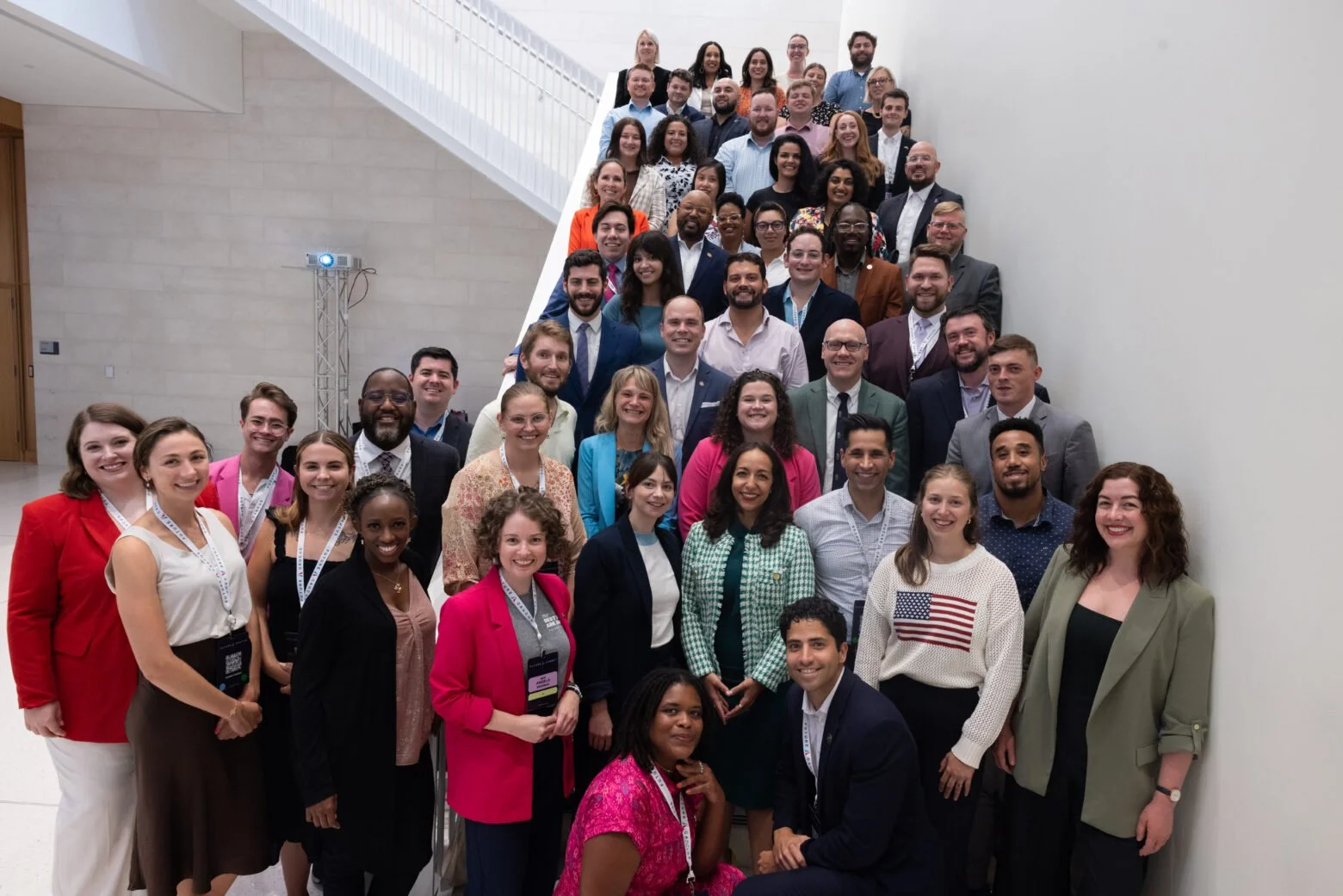
Layla Zaidane, center in green, with young lawmakers in the Future Caucus network | Credit: Future Caucus
FIDE - North America advances a democratic culture that is inclusive, responsive, deliberative and holds government accountable in between elections. Committed to a democratic process through narrative change, systems change and impactful citizens’ assemblies, FIDE – North America strengthens the deliberative community, advocates and raises awareness, provides technical guidance and builds capacity, develops independent case studies and best practices through a rigorous learning series. We hope you find this newsletter useful and informative. —Ansel Herz
“Gerontocracy” refers to a society that is run by the elderly. The average ages in the U.S. House and Senate are 58 and 64, respectively. Less than 7 percent of Congress is under 40, while the median age of Americans is 39.
According to data from the Future Caucus, only 25 percent of state legislators today are younger than 45-years-old. But there’s a big silver lining in the data: Those 25 percent are responsible for some 40 percent of bipartisan legislation that has been signed into law.
To understand better why that is — and what the relevance of citizens’ assemblies (CAs) may be to new generations of lawmakers — we spoke to Layla Zaidane, President and CEO of Future Caucus. — Ansel Herz
What does the Future Caucus do?
Future Caucus is the country’s largest bipartisan organization for Gen Z and millennial lawmakers, formerly known as Millennial Action Project, with nearly 2000 lawmakers in its network.
Our mission is, how can we connect and equip the next generation of elected leaders to transform American politics? What does it look like to have a healthier set of democratic institutions? Can we help these lawmakers build connections along a generational identity and not a partisan identity? How does doing that potentially unlock opportunities to do things outside of the binary left-right paradigm?
What are some examples of your work?
Most political discussions focus on what goes into specific legislation. We’ve had success in flipping that on its head. Actually, the most important thing is trust in order to get things done. If there’s trust, then any number of issues have a greater likelihood of seeing durable change.
When we launched the Georgia Future Caucus, one of the most progressive members of the Democratic Party and one of the most conservative members of the Republican Party, both under 45, joined our launch. The Republican member is known for voting no on every bill as a way of demonstrating his priorities — but Future Caucus was one thing he said yes to. These partnerships wouldn’t happen without us.
Why was he supportive of Future Caucus’ work?
One of the most radical things we do is we consider elected officials as people, not pawns on a political chessboard.
The experience of a young person who has run for office can feel lonely. It can feel, especially at the state level, like you’re underpaid and overworked and under-resourced. We offer support.
We don't have a specific policy agenda that we're asking them to advance. They identify bills that are important to them. In Oklahoma, a Republican co-sponsor from the Future Caucus joined a Democrat on a harm reduction bill to get needles off the street. We give lawmakers the opportunities to think creatively, to trust each other and to do good things.
Is it difficult to overcome the incentives to do politics in a highly polarized way?
I'm not sure how many billions of dollars were spent in the last election, but it’s orders of magnitude more than what Future Caucus or peer democracy organizations are spending. There are real forces that are pulling people apart.
We’re missing visible examples of how leaders who govern in this collaborative style are able to find continued political success. A big part of our work has been narrative building, to tell the stories of our members who are able to lead constructively, build coalitions, and to get reelected, to move up into committee chairs or minority or majority leader roles.
How would you characterize the millennial set of legislators?
Our research shows that 25 percent of legislators are 45 years old or younger, but they are responsible for 40 percent of the bipartisan legislation that gets signed into law. That's huge.
Millennials, having grown up with more access to digital communications tools, are able to be more authentic online. It’s not that older folks aren't able to do that, but I think it just comes more naturally.
Where do you see citizens’ assemblies fitting into this picture?
I have a nuanced view of these tools. One huge upside is this: they're solving for a core problem in our American democracy, which is that people feel their voices don’t matter in the decisions that are being made which impact them.
If that's missing, then we've lost the plot, right?
At the same time, it’s important that policymakers are involved at key moments throughout the process so that these time-intensive deliberative dialogues drive real change and outcomes. Otherwise, it could be demotivating for constituents.
Legislators often feel there's a push and a pull. There's no way to please everyone 100 percent, so their job is to weigh the tradeoffs and make responsible and representative policy decisions. With an assembly process in the mix, they can say, “I had a diversity of citizens who were randomly selected from all different backgrounds to study this in depth, and this is what they came up with.”
This mini-representation of a constituency can create a powerful starting point or legitimacy for a certain set of policies, because there's been so much citizen input and deliberation that has gone into it. Ensuring there's a thoughtful way to involve lawmakers during the process can strengthen the political feasibility of a solution.
Your post-election polling shows that 84 percent of American voters prefer a leadership style of working together respectfully with integrity toward solutions, rather than asserting power. This kind of leadership is more incentivized in the assembly environment.
This is where citizens’ assemblies are helpful. People don’t empathize with the position that legislators are in. They’re having to make tough decisions and having to figure out how to balance a million different competing priorities. It doesn't help that politicians are mostly presented as caricatures, or often get attention by using highly emotional appeals.
The more we can give Americans the experience of what it takes to make big decisions that take into account many people’s needs, the better. Most reasonable people understand that you have to do something that works for everyone. More CAs can help us create the norms and culture to transcend polarization.
This is a chaotic time. We're in the middle of a political realignment. But I feel very hopeful about the innovations and thoughtful people in civil society and government who are trying to get creative to improve the process of democracy. I feel like this is an exciting time to be doing this work.
Spotlight: The Victoria-Saanich Citizens’ Assembly on Amalgamation
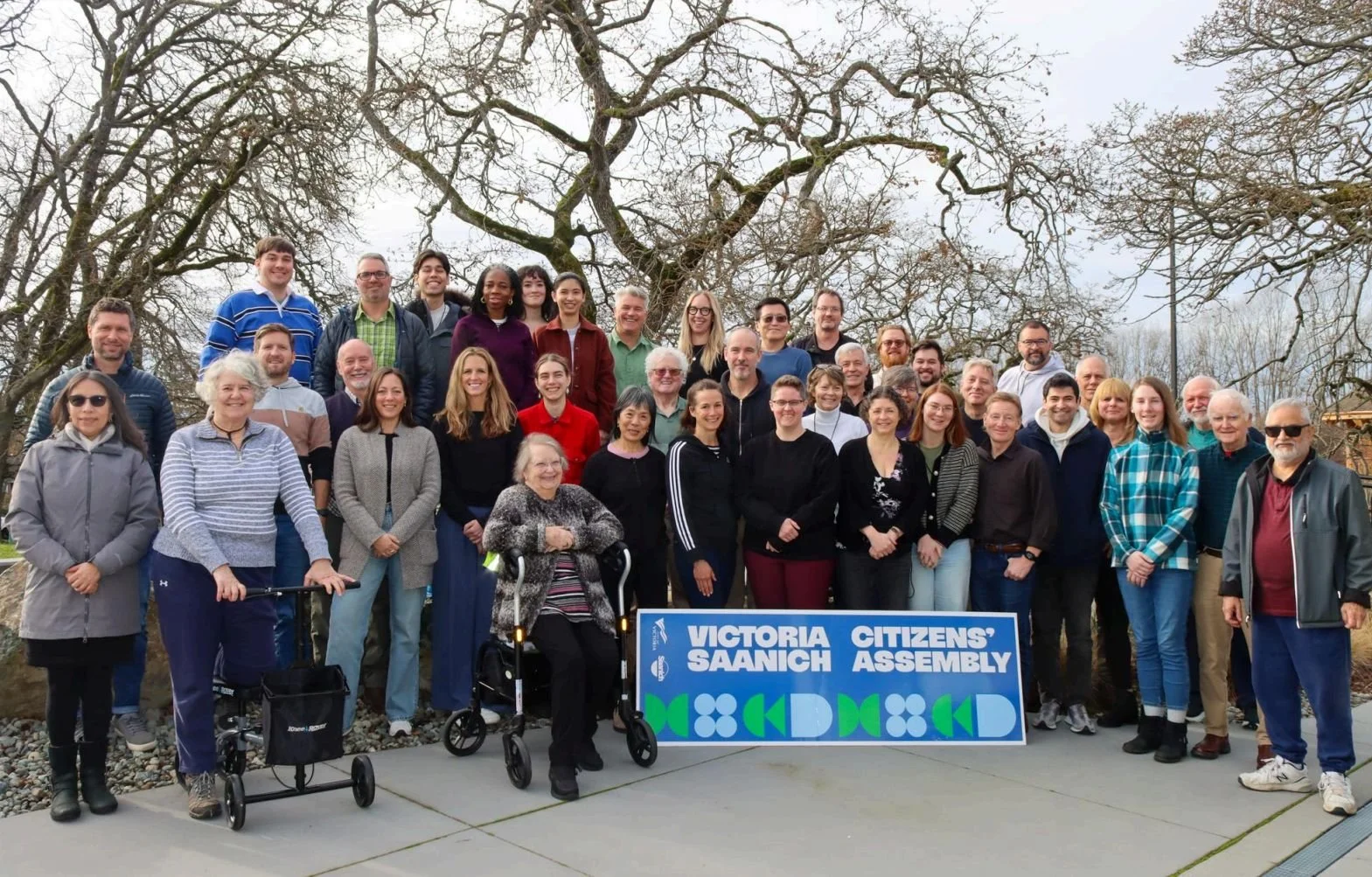
Over the past eight months, 48 residents have deliberated about the future of Victoria and Saanich, two municipalities on the southern end of Vancouver Island in British Columbia, Canada.
On April 8, the Victoria-Saanich Citizens’ Assembly (VSCA) concluded its deliberations and recommended the neighboring municipalities should — after a public referendum on the idea — amalgamate, in order to better manage future growth, integrate emergency services, and improve resilience against natural disasters.
“In the course of our deliberations, we ultimately concluded that amalgamating and becoming a unified city is the best form of government for our two municipalities,” the assembly members recommended.
The assembly held 8 full-day sessions, totaling nearly 60 hours of deliberation, and heard presentations from 19 guest speakers, experts, and stakeholders. The assembly consisted of 27 residents from Saanich and 21 from Victoria.
One assembly member remarked that they came to the assembly with very strong opinions and zero knowledge about this specific subject. Through the deliberative process, assemblies flip this equation, helping citizens emerge with informed judgments and extensive knowledge of their subject.
Another assembly member said, “My involvement in the assembly is driven by a desire to contribute to the continuous improvement of our community.”
Miles Brackenbury is the Lead Evaluation Fellow for the assembly, as part of FIDE - North America’s Learning Series. Miles observed multiple sessions and conducted surveys to track attitudinal changes among the assembly members.
Now that deliberations have concluded, Miles will interview members, facilitators and others and will compile data and learnings into a report due out this Fall.
On the question of how the process of deliberation affected members' perspectives, an overwhelming 97.37 percent (37 out of 38) responded that it increased understanding and respect for other perspectives. The same proportion recommended that others participate in a deliberative process.
Miles said he could feel how excited and empowered assembly members were throughout the process, particularly in the last session. He observed how important it was, in seeking consensus, for assembly members who supported or opposed amalgamation to be given assurances that their views were heard and represented in some way, even if the outcome didn’t exactly align.
He was also struck by how critical the mandate or remit of the assembly is.
In this assembly, the members knew their recommendations would be sent to referendum. This made them accountable to the public, but also may have constrained their recommendations, because they were conscious of the need to translate their recommendations into something that would go to a ballot. Miles said one of the key questions is how to connect the “mini-public” to the “maxi-public.”
Additionally, as part of the VSCA Chair's Advisory Group, FIDE - North America provided technical guidance and advice on process design and implementation.
Reserve Your Spot at Our Next CA School

Akron has always been a city that rises to the occasion—literally and figuratively. Perched at the summit of the Ohio and Erie Canal, its very name comes from the Greek word for “high point,” a nod to both its geography and its enduring spirit of innovation.
From its days as the “Rubber Capital of the World” to its leadership today as a hub for entrepreneurship, sustainable polymers, and, healthcare, Akron has never shied away from reinventing itself.
Today, Akron’s energy is focused on building a more participatory future. That’s why we’re excited to announce our partnership with Unify America to organize our upcoming Citizens’ Assembly School! Save the date and use the link below to register.
At Busboys and Poets in D.C, “Activated Citizenship”!

In Washington D.C. on May 18, join Marjan Ehsassi at Busboys and Poets to learn how deliberative democracy can reinvigorate citizen engagement and address key deficits in our governance structures, in a discussion of her book “Activated Citizenship.” Copies of the book will be available for purchase during and after the event, and Ehsassi will be signing following the program. This event is free and open to all. The program begins at 6:00 pm, and will be followed by an audience Q&A. Please note that this event is in person and will not be livestreamed.
A Citizens’ Assembly meets a specific set of deliberative principles, including representativeness by democratic lottery or sortition, time, information, accountability, deliberation, and a free response. Learn more about the core elements of Citizens’ Assemblies in our Introduction to Definition and Guidelines paper, including how assemblies compare with other deliberative instruments.
IIn case you missed it:
It’s time for a fourth branch of government — FIDE - North America joined People Powered in a bold call, published in the Boston Globe, for a new branch of American government based on deliberation and sortition. “A House of the People could go a long way toward rebuilding the public trust in government that our democracy needs.
Read Applying Seven Principles for Citizens’ Assemblies to the Yukon Citizens’ Assembly on Electoral Reform from Yukon professor Sara McPhee-Knowles, an in-depth look at how the deliberative and design principles outlined in FIDE’s Introduction to Definitions and Guidelines were applied in Yukon’s CA.
CityChangers published an in-depth interview with Ehsassi on her work, covering everything from the key ingredients of successful CAs, research in Activated Citizenship, and FIDE - North America’s current projects.
Volunteers welcome!
Want to contribute to the future of democracy? Contact us if you’d like to join a team of volunteers who are helping support FIDE’s programs. FIDE - North America has a new office:
Open Gov Hub
1100 13th St NW
Washington DC
We hope to see you at an event, whether in-person or virtual, this year! For more, follow us on LinkedIn or join us over at our new account on Bluesky.
Until next time,
The FIDE - North America Team