
After Brussels: takeaways from Democracy R&D and what's next?
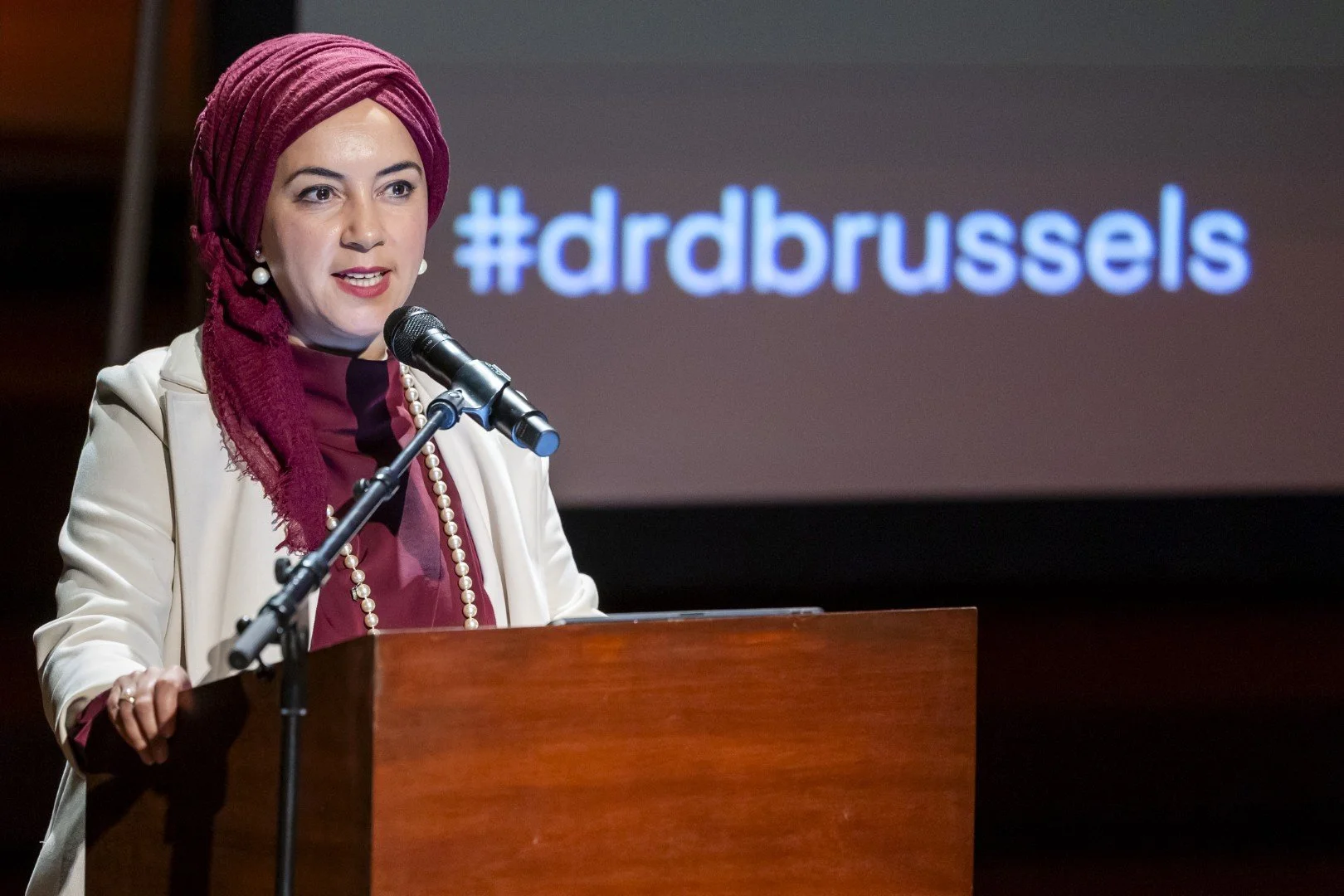
Fatima Zibouh delivering her keynote at Democracy R&D 2025. Pictures: Geert Vanden Wijngaert
The global network of democratic innovators brought 270 participants to its biggest and most diverse meeting to date. Practitioners, public officials, and advocates spent four days swapping methods, comparing realities, and testing where the field goes next. If you didn’t attend or if you are new to this field, here we curate the ideas that stuck, with recordings to relive their highlights.
And if you read until the end, you’ll find a glimpse of what’s next: how we’re carrying this momentum forward from Brussels into 2026.
FIDE – Europe, October 2025
Is sortition inclusive enough?
In her keynote, Fatima Zibouh challenged us. She invited us to rethink participation from the ground up.
She reflected on the local reality, not just as Europe’s capital, but as a living experiment in diversity and democracy. With more than 180 nationalities and over a hundred spoken languages, it is one of the world’s most cosmopolitan cities—yet also a place of sharp contrasts, where many worlds live side by side but rarely meet.
Drawing on her experience with the original G1000 initiative, Belgium’s pioneering citizens’ summit, she argued that inclusion cannot rely on goodwill. It must be built into the design of our democratic processes. “Diversity is being invited to the party, inclusion is being asked to dance, but radical inclusion means helping organise the party,” she remarked.
She called for a shift from invited participation to claimed spaces where communities design, host, and shape the democratic process itself. Her message was clear: only when those most affected by decisions help organise the process can we speak of genuine inclusion.
Deliberation works. Prove us wrong.
The deliberative field has spent years proving its worth; now we must flip the script.
Deliberation is not a prototype—it’s a tested approach that improves decisions, trust, and legitimacy. Rather than asking for permission every time, deliberative advocates need to communicate results clearly and place the responsibility where it belongs: on those who choose not to act.
Ignoring deliberation is no longer a neutral choice; it is a decision to overlook evidence. Stronger storytelling, sharper communication, and strategic visibility are necessary to portray sortition and deliberation as the new democratic mandate.

Panel ‘Who Really Gets a Say Around Here? Cities’ Approach to Inclusion & Other Realities.’
From left to right: Sara McPhee Knowles, Ljiljana Kolarski, Indira Latorre, Fatima Zibouh
Building lasting democratic infrastructure
The shift from short-term projects to permanent assemblies is gaining traction.
The Permanent Assemblies in Belgium event, hosted at the Brussels Parliament, showed that permanence allows citizens and administrations to learn across cycles, instead of starting over each time. The Belgian examples demonstrate that these models are feasible and reliable; they only need political commitment and stability to show their strengths.
Permanence is not a technical upgrade; it’s a political choice. It demands commitment from leaders, continuity inside administrations, and clear pathways from citizen input to policy. Representatives from Ostbelgien, Brussels Parliament’s deliberative committees, and Brussels Climate Assembly shared the need for long-term investment in the teams, networks, and structures that make participation routine rather than exceptional.
At FIDE – Europe, this work continues beyond the conference. If you’re building a permanent deliberative process, get in touch — we are convening early adopters to share insights and help permanent models take root. Watch this space to learn more.

‘Permanent Assemblies in Belgium’ at the Brussels Parliament, October 14th.
All Democracy R&D recordings
What’s next?
Upcoming Trainings
We are working on a new range of programmes to build deliberative capacity and bring new professionals into this field. We will continue to organize our foundational Citizens’ Assembly Schools –details coming on its upcoming location and date– but noticed many of you were asking for more.
Assembly leads and facilitators require in-depth training programmes that are currently scarce. To close this gap, in partnership with other European organizations, we are developing a Deliberative Lead Facilitator Masterclass.
It is aimed at anyone with some experience facilitating citizens’ assemblies –or other mini-publics– that would like to take this craft to the next level. The masterclass will be hosted by –and feature expert trainers from– a partnership of some of Europe’s leading deliberative organisations, including We Do Democracy and nexus.
The first masterclass programme will start in June 2026. Much more information on this beginning of next year. Interested? Express your interest at info@fide.eu
Advocating for deliberation at the EU level
You might remember our EU elections pledge campaign, For a Democratic Wave.
Together with Democracy International e.V. and with the support of other NGOs, we called on Members of the European Parliament to support the creation of an Intergroup on Democracy—a first of its kind—to promote democratic principles and enhance citizen engagement across all legislative and non-legislative work. Although the proposal gained support from representatives across the political spectrum, the bid narrowly missed out.
In the coming months, two important dossiers will be on the EU agenda: the Democratic Shield initiative and the new Multiannual Financial Framework (MFF)—the EU’s seven-year budget. We will step up coalition-building and advocacy efforts to ensure that citizens’ participation remains at the top of the priority list.