Proof of What’s Possible in Two Years
Key accomplishments over the past two years.
Dear friends and colleagues,
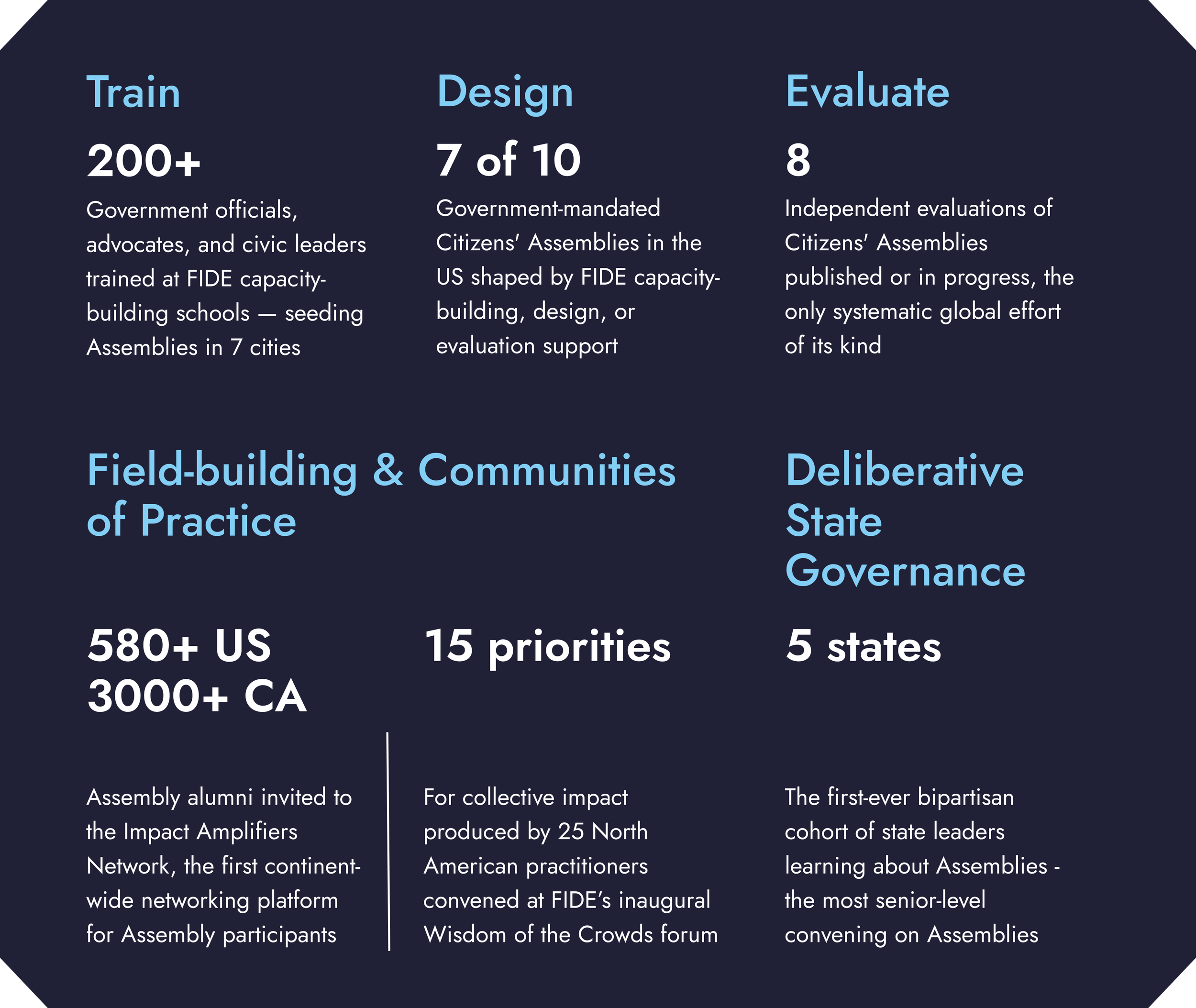
A little over two years ago, I began discussions with FIDE — Europe about a plan to launch a sister organization in North America. Our mission was clear, to advance a democratic culture that is inclusive, responsive, deliberative, and holds government accountable in between elections. Since our kick off in April 2024, I have been deeply inspired by the strides our organization has made towards achieving this goal, with a robust Learning Series, a Theory of Change, a Deliberative State Governance initiative with the most senior state-level delegation to convene on citizens’ assemblies, and an expansive Partnership for Local Citizens' Assemblies building capacity and offering on-going technical support to local processes across the continent. We also held the Wisdom of the Crowds, the first convening of 23 Citizens' Assembly implementers in January, 2026.
When it comes to institutional reform, we are at a tipping point. Citizens are growing increasingly frustrated over what we refer to as “voice insecurity” and a lack of consequential input. At the same time, governments are increasingly recognizing the need to change the way they engage and serve their constituents effectively. The health of our democracy requires renewing our social contract, reinvigorating our democratic practices, building mutual trust, and finding new pathways for collective problem solving that put the public in public policy.
As interest grows, we are witnessing many trends. We commend our colleagues who are incorporating new and innovative technologies into mass deliberative processes. We are excited to learn from these developments, as well as continue to advise and evaluate several upcoming assemblies with a focus on new tech and artificial intelligence. FIDE - North America's work will always center on strengthening the connective tissue between government and constituents. We do this by designing processes for legitimacy to shape effective co-creative policy reform with strong feedback mechanisms to hold government accountable.
So, what’s next? We are developing M&IE indicators for CAs and launching the Impact Amplifiers Network (IAN) to bring participants from across assemblies together for greater storytelling, policy impact and training. When people come to FIDE - be it potential assembly implementers, local governments, academics, practitioners, or everyday citizens - there is true excitement for our collective goal and mission. FIDE - North America will continue to focus on what we do best, identifying strategic opportunities for growth, harnessing the energy throughout the field, putting the pieces together, and turning it into concrete action.
This work is only possible because of the tremendous support we receive from our friends and partners in the field, our exceptional Board of Directors and remarkable Advisory Committees, our donors who believe in what we do, and of course, our incredible team that I have had the privilege to build and watch grow.
With that, I hope you enjoy the below conversation between two of our terrific team members reflecting on the two-year anniversary of FIDE – North America, their passion for the work they're doing every day, and ambitions for the organization’s future.
With deep respect and gratitude,
Marjan Ehsassi
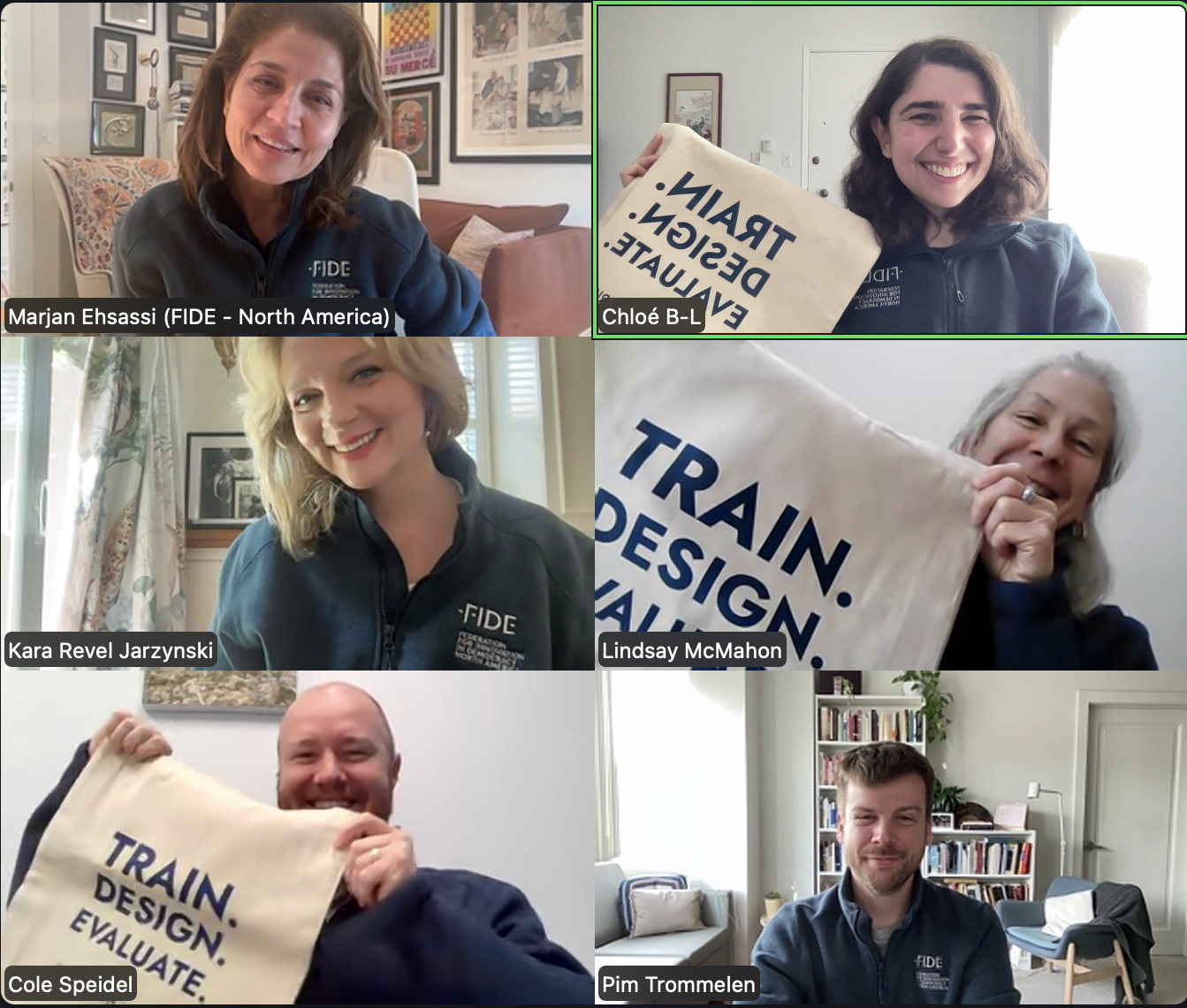
The following conversation is between FIDE — North America’s Chloé Borenstein-Lawee (Interim Manager of Communications and Impact Amplifiers Network) and Cole Speidel (Program Manager). The interview has been lightly edited for brevity and clarity.
Chloé Borenstein-Lawee: Cole, thank you for joining me. Why don’t we start with what you do for FIDE – North America?
Cole Speidel: I am the Program Manager at FIDE - North America. My main work is with local and regional governments around the US towards improving democratic public engagement and accountability. Day to day, that means I develop and help lead training, our capacity building schools and design workshops for local government and community leaders interested in assemblies. Some of my work involves what we call the ‘enabling environment’ - helping remove barriers to government-commissioned citizens’ assemblies. I also have operational tasks - I write proposals, handle contracts and liaise with local government and implementers, draft public reports for programs or events we’ve run. And I used to run our socials until you - thankfully - joined our team!
CBL: Do you enjoy that kind of work, being a bit of a Swiss Army knife?
CS: Absolutely, it can be very fun and rewarding. The work that we do, we're very focused on the mission. I've had several pinch-me moments. Most recently in Central Oregon for a local training, that's work I love to do be somewhere in the United States I've never been before, talking to all kinds of people trying to solve local problems, and learning about their communities. And they're there because we're offering them something valuable. And that to me is awesome, and great fun.
CBL: How did you first learn about FIDE?
CS: Well, before FIDE, I worked on international democracy and governance programs for an organization called the National Democratic Institute (NDI). I got to learn about how local governments work in Georgia, Morocco, El Salvador, Poland, Ukraine, Thailand, all over, and help our global team develop programs with local and regional government institutions. That was my first introduction to deliberative democracy. I went to a conference in Romania, where Marjan [Ehsassi] was speaking. And she talked about her book and about citizens assemblies.
CBL: You’re kidding. So, that’s where you met her?
CS: No, I didn’t manage to meet her at the conference, but I had my interview almost a year later. FIDE’s work was a natural extension of some of the work that I'd been doing overseas and was a great opportunity to do that work in the United States.
CBL: And you’ve been at FIDE for a year, right?
CS: Yes - April 28th, 2025 was my first day. My wedding anniversary happens to be April 19th - I got the job offer the same week I got married. So that’s kind of a quirky way to remember it. How long has it been for you, now?
CBL: Just a couple months. But that brings me to my next question, it’s a self-serving one - as I describe this work to people, I get asked all the time to explain what a citizens’ assembly is. What’s your elevator pitch?
CS: I was just at a family event and I got this question a lot. My elevator pitch for assemblies is it's a method of public problem solving. Governments have challenges with outreach and engagement. And this is a way of reaching past the usual suspects and bringing everyday folks into the conversation to work on policy solutions.
CBL: Perfect, thank you, I’m stealing that. With that in mind, what you think FIDE - North America's value is to the field? Why does this space need us?
CS: We are really good at filling the strategic gaps. And I think we are a catalyst. We do training that brings people to the space, not just for people who are new to this, but also for implementers. And we do that bridging work between implementers and government.
CBL: Yes, I agree. I haven’t been here long but it’s clear we take a bird’s-eye view to the field. Our partners are in the weeds running their processes, and that style of work can lead to them getting siloed without someone forcing them into one room. Just like the Wisdom of the Crowds report you did, convening implementers in the field.
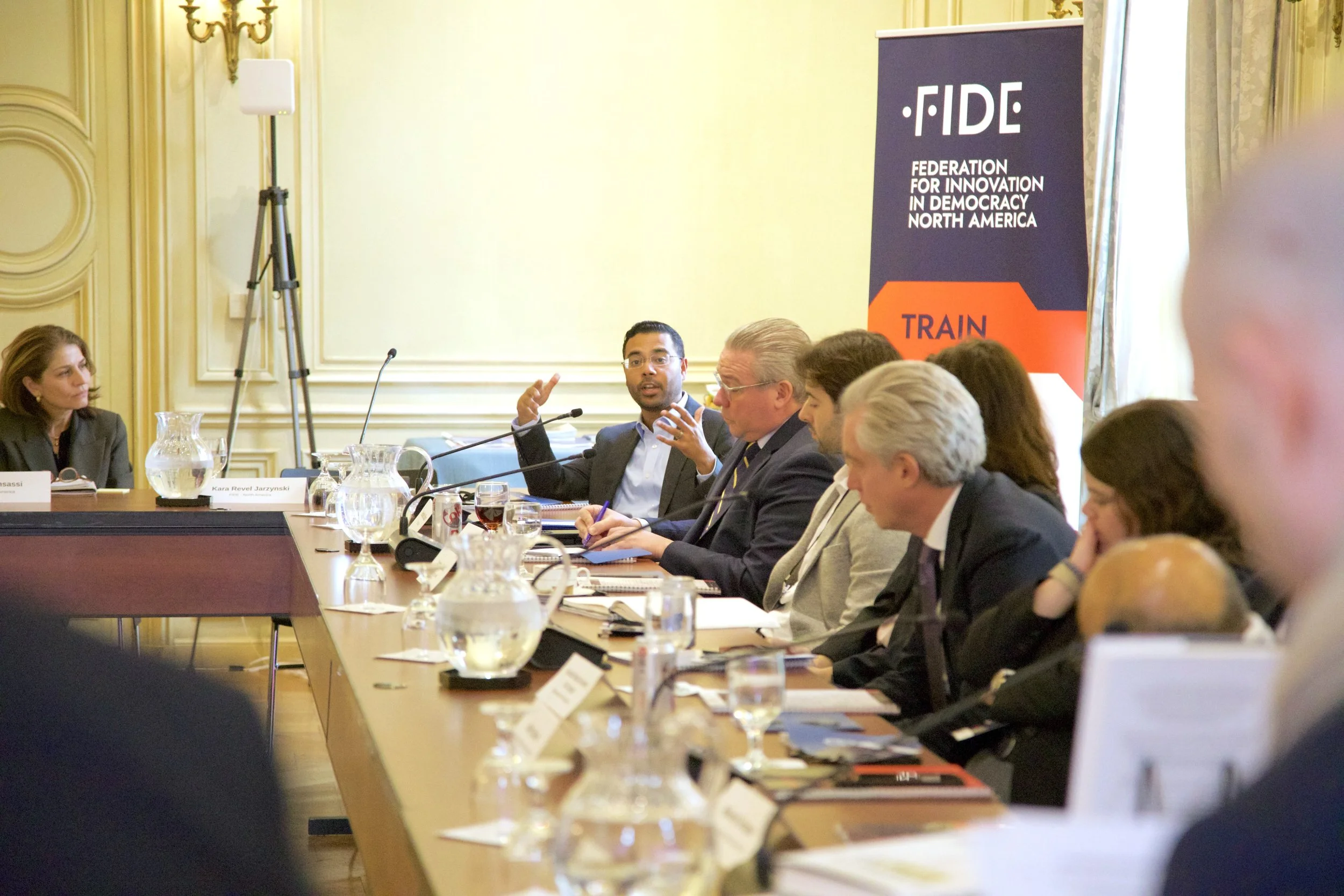
CS: That's something that I worked hard on and really enjoyed. Something I think we do well is that we're very collaborative as an organization, and naturally so. We don't implement citizens assemblies, which opens the door for us to be able to partner with government and practitioners to help bridge their work, improve design, provide examples and evaluations, whatever adds value. For Wisdom of the Crowds we brought together 23 Assembly implementers in DC, and it was wonderful, very collegial. I think the secret sauce for the day was not only convening the right people - people who have been there and done it - but intentionally giving them the floor to talk to each other about actual processes, challenges, tough decisions they face. And you could just see the room lean in. Everybody was excited to be there. I feel very lucky to be at an organization where I can facilitate days like that and build those relationships as a partner to not only to government, but to the folks who have been doing this work for years and have such a wealth of knowledge about it. And they’re motivated to see the field grow. We used those discussions to make a strategy for how we can scale up this work towards government adoption.
CBL: I think that the innovation that you get from an initiative like that is incredible. All of these implementers are creating their own value, and so our value is the aggregation of that. FIDE puts it all together and holds that collective work and data up to the light in order to create meaning within the larger context.
CS: Yes, the democracy reform space in the United States is massive, you need an org like FIDE to bring it all together for citizens’ assemblies.
CBL: What do you think makes the FIDE – North America team so special?
CS: I think we are optimists. We have a clear center of gravity, and I think we stay true to our focus.
CBL: That’s been my experience. This team has such huge goals, but no one ever seems daunted by them. There’s a real sense that this work is too important, and anything can be achieved with the right approach. I think that's very impressive. Which brings me to my last question - Do you have any goals for this next year?
CS: One year from now, I want the institutionalization of these programs and of this work. After Wisdom of the Crowds we wrote an after-action report listing 15 concrete initiatives that - as a field - we can do over the coming year. I’m excited to enact some of those, especially the groundwork with government. I want to see what cities, counties, and different institutions - even universities - can do with citizens’ assemblies. That's what we mean when we talk about building demand for this work. Adding this to the government toolbox and positioning them to commission these processes with trusted implementers, so that if we come across an issue that's thorny and gridlocked, this is something our political leaders can draw on. What about you? What are your goals?
CBL: I’m excited to get the Impact Amplifiers Network (IAN) off the ground. It's going to be an online platform for all past participants of citizens' assemblies, which I think will be both useful and unique. When I first joined this project, I thought it would be a great tool for implementers. And then I was reading through the case study for Boulder and the real sense of community that formed. Assembly alumni are so revved up, they're ready to participate and engage civically, so providing something for them over the next year is a thrill. From a communications standpoint, over the next year, I want FIDE to become a recognizable name beyond the core practitioners in the space. If a community decides they want to create a citizens’ assembly, I want the first place they go to be FIDE's resources, we already have 3 case studies, our Theory of Change, our publications – everything they need for a how-to guide.
CS: Absolutely. One day, through my work at FIDE, I want there to be no fewer than 10 really good assemblies happening around the country at any given time. And I want to be able to attend every single one of them!
What We Are Up To
Partnerships with Local Citizens’ Assemblies
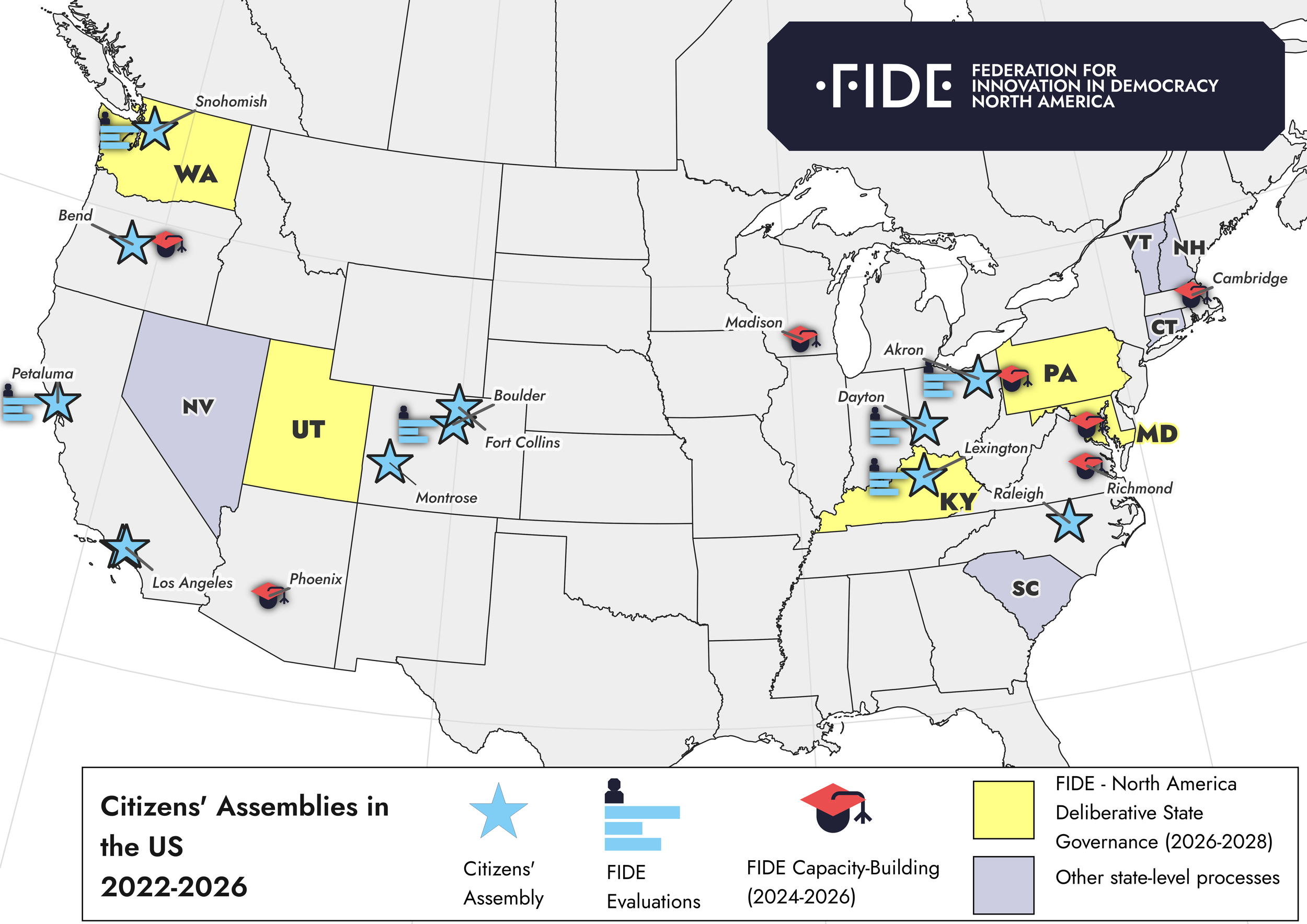
CivicLex’s Civic Assembly in Lexington, KY, which took place in March of 2026, and presented their recommendations on changes to Lexington's Urban County Charter at April 28th's General Government and Planning Committee. We were proud to offer technical guidance and act as lead evaluator for the Assembly.
We have also partnered with Snohomish County as lead evaluator and technical advisor for the Snohomish County Civic Assembly, which launched on May 2nd. The Assembly brings together 40 randomly selected residents to deliberate on the future of AI use in Snohomish County government.
Deliberative State Governance (DSG)
We are thrilled to introduce the 2026 cohort for our Deliberative State Governance initiative.
The inaugural cohort features state leaders from Kentucky, Pennsylvania, Utah, Maryland, and Washington. Members include:
— Secretary of State Michael Adams (Kentucky)
— Secretary of Policy and Planning Akbar Hossain (Pennsylvania)
— Senior Advisor for Legislative Affairs and Policy to Governor Spencer J. Cox, Neil Abercrombie (Utah)
— Official designee of Lt. Governor Denny Heck and Executive Director of the William D. Ruckelshaus Center, Julia Carboni, Ph.D. (Washington)
Over the course of 2026, our initiative will share with these state leaders the value of implementing structured deliberative democracy and giving constituents a consequential voice in policy decisions.
When asked about his participation, Secretary Adams of Kentucky said, “Citizens’ Assemblies are not only valuable in the abstract; they are practical and adaptable, and they may be genuinely helpful to Kentuckians I serve. I appreciate FIDE’s clear, thoughtful structure for supporting state officials: early stage presentations and workshops; international exchanges that bring Citizens’ Assemblies to life; and ongoing strategic and technical guidance…I am eager for Kentucky to continue participating in this work.”
In Washington, Julia Carboni agreed, “As we consider next steps, our questions are practical ones: where a deliberative process would add value, how it would be structured, and how we ensure it reflects the full diversity of Washington’s communities. Your team’s willingness to support that exploration — through education, comparative insight, and technical guidance — is appreciated. I look forward to continued collaboration as Washington evaluates what is possible.”
In just two weeks, the cohort will next travel to Brussels, Belgium to engage in meetings with international government counterparts and to observe the European Citizens' Panel, an EU-wide Citizens' Assembly.
For more information on the DSG program, please contact our Strategic Director, Deliberative State Governance, Kara Revel Jarzynski: kara@fidemocracy.org.
Our Partners in the News:
— New York Times, No Shy Person Left Behind (Published April 7th, 2026)
— New Hampshire Public Radio, New Hampshire Forum seeks common ground for bipartisan solutions and civic engagement (Published April 8th, 2026)
— Culver City Crossroads, Civic Assembly Participants Will Be Selected (Published April 9th, 2026)
— WTNH, First Citizens’ Assembly in Connecticut works to tackle property taxes (Published April 24th, 2026)
— Colorado Boulevard, Democracy by Lottery: The Rise of Citizens’ Assemblies (Published April 28th, 2026)
We’d like to congratulate our partners for the incredible work they are doing putting the public back in public policy. See the full scope of our advisory and evaluation work below.