
What is the role of deliberation in times of crises?
There is a growing need to reflect on our place amid a global democratic backlash. With this editorial, we pause to acknowledge the struggles of many in the fight for freedom and democracy.
Up next, we turn to how we continue to build alliances and capacity for a new era—one that can only emerge through relentless perseverance.
FIDE - Europe, April 2025
Last week, I was asked to do a presentation to a group composed of students from Georgia and Abkhazia by a good friend of mine. The friend is an academic from Turkey who has recently become a fellow Belgian. Preparing my talk the evening before, I wondered what I had to say to young people who come from a place where daily demonstrations against an authoritarian takeover have been going on for over 100 days. Or to my friend in the back who just heard that the elected mayor of the biggest city of her native country was arrested in what clearly looked like a spectacular episode of further democratic backsliding…
If your democratic house is ablaze, what does exploring deliberative democracy mean?
The first thing I felt was needed was to start by acknowledging to them that the urgency of their situation has precedence in the order of democratic gravity to what I was going to present. While we didn’t print it on everything we did in the past (because we found it obvious), for FIDE, free and fair elections are a prerequisite for anything deliberation you would want to build on top of that. Moreover, elections are only one part of the deal. A regime is only a democracy if human dignity, freedom, equality, the rule of law and respect for human rights are guaranteed. If you run citizens’ assemblies and these things are absent, you have all cherry and no cake.
If you are threatened with legal sanctions through face recognition technology for taking part in a celebration of your self-expression or for demonstrating, we are on your side! This sounds obvious, but recent times made me feel we need to state it explicitly and loud.
As I was still somewhat struggling with the awkwardness of it all, I could find no better solution than to use a known meme to be my backdrop for that part...This extra slide didn’t make my traditional slide deck heavier, as I could also delete a few slides. It feels hard (even surreal) to believe, but until pretty recent I would still get the occasional pushback that we maybe “overstated the problem with democracy”.
On the other hand, it is our position at FIDE that these crises are increasing because there is a structural fragility in the design of contemporary democracies. While we need to extinguish the fires that are threatening it right now, if our democratic house is metaphorically made of dried straw, we will never stop doing only that (or even see it burn down). We believe that there is a way to build more resilient democracies and that while it may take long years to see real structural change, the first bricks of that house need to be put in place someday. And that day was yesterday. In the meantime, we are proud that we can work in the shadow of those who are fighting in the struggles of today, so we can play the “long game”. Many in the FIDE family (staff, board members, deliberative friends) are directly affected by autocrats and feel that tension in a direct and intense way. They are on our minds every day.
At the end of my presentation, my audience was exhausted. Some part in me put it to the fact that for visa reasons, they had landed in Amsterdam instead of Brussels late the night before and had a 3,5 hour trip in a minivan behind them to hear me speak. During the coffee break, a student came to me and said, “I will want to look a bit into some of these things. We are fighting now every day, but we are also wondering amongst us how to make decisions and what we want the day this will be over”. I can only admire those like him who step up to water cannons while I fiddle on my next presentation.
Yves Dejaeghere,
Executive Director
Permanent Assemblies Workshop
Brussels — May 8-9
As democratic innovations spread, so does our ambition to make them last. Permanent assemblies mark a crucial shift from one-off consultations to embedded democratic practice. By giving randomly selected citizens a standing place in policymaking, they open up space for long-term thinking, deeper legitimacy, and more resilient institutions.
Are you planning a permanent citizens’ assembly?
We’re inviting city and regional delegations from across Europe who are developing or already running permanent assemblies to join this hands-on knowledge exchange.
Building on last year’s gathering of early adopters, this workshop offers practical support for those reassembling the architecture of democracy — not for the next event, but for the long term.
The focus: how to move from pilot projects to permanent infrastructures for citizen deliberation.
You'll hear from Nabila Abbas and Graham Smith (authors of the KNOCA guidance paper Towards Permanent Climate Citizens’ Assemblies) and learn directly from peers piloting assemblies in their own contexts. Expect deep-dive discussions on challenges like agenda-setting, participant retention, political anchoring, and long-term funding. In partnership with the European Climate Foundation and KNOCA.
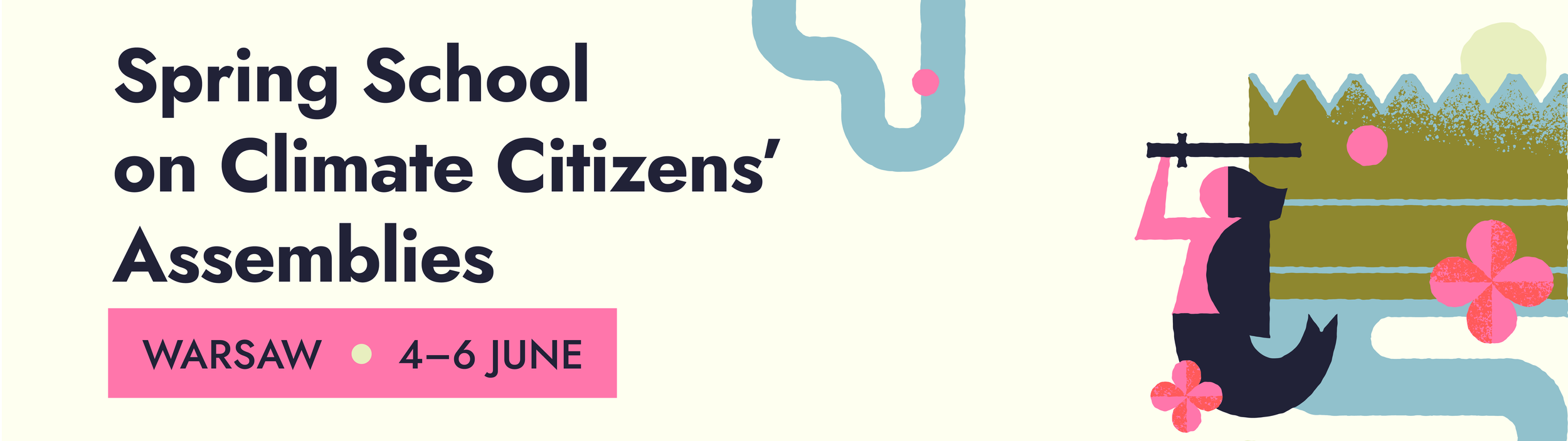
In recent years, Poland has faced democratic challenges, prompting renewed interest in citizen engagement and deliberative democracy. Civil society organizations, some of which have been active for over a decade, have played a key role in fostering a culture of participation. As a result, Poland has become one of the most active countries in Central and Eastern Europe when it comes to organizing citizens’ assemblies.
The Spring School on Climate Citizens’ Assemblies offers a unique opportunity to gain practical skills in designing and running deliberative processes. In collaboration with experienced local organizations—the Shipyard Foundation, Field of Dialogue Foundation—and the City of Warsaw, the school combines hands-on training, case-based learning, and interactive group work.
For the first time, we are adding a Deep Dive on Involving Children and Youth in Citizens’ Assemblies in partnership with Child Rights International Network (CRIN). An essential step toward making deliberative processes more inclusive and ensuring democratic futures that reflect the voices of all generations.
Supported by KNOCA and the European Climate Foundation.
Competency-building workshop in Strasbourg
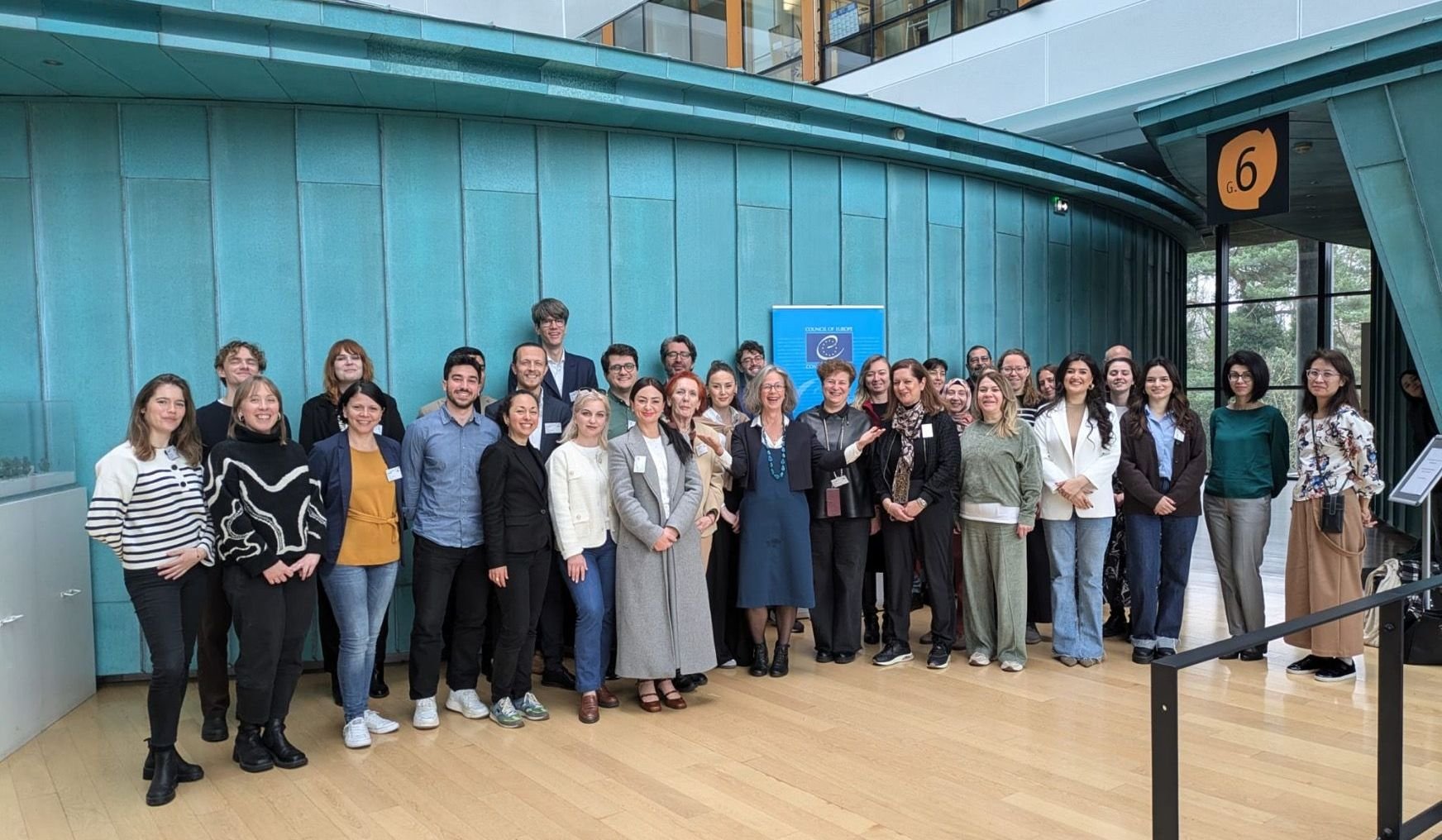
How much can you learn about Citizens’ Assemblies in 2 days?
That’s what we pushed the limits of during our latest competence-building workshop with the Council of Europe in Strasbourg. 30 representatives from 12 countries, evenly split across civil society organisations and public administrators met to learn from our team and international experts. We planned prospective citizens’ assemblies on nutrition, municipal amalgamation, air pollution, anti-corruption and community cohesion.
One recurring theme, even among our experienced experts, was the difficulty of political uncertainty. Even the best-tested plans can come unstuck when parliaments are dissolved or political parties exchange power. We determined that the best way to survive such challenges is for citizens’ assemblies and deliberative innovations to have broad appeal to all actors —no easy feat!
Democracy R&D 2025
Brussels — October 15-16
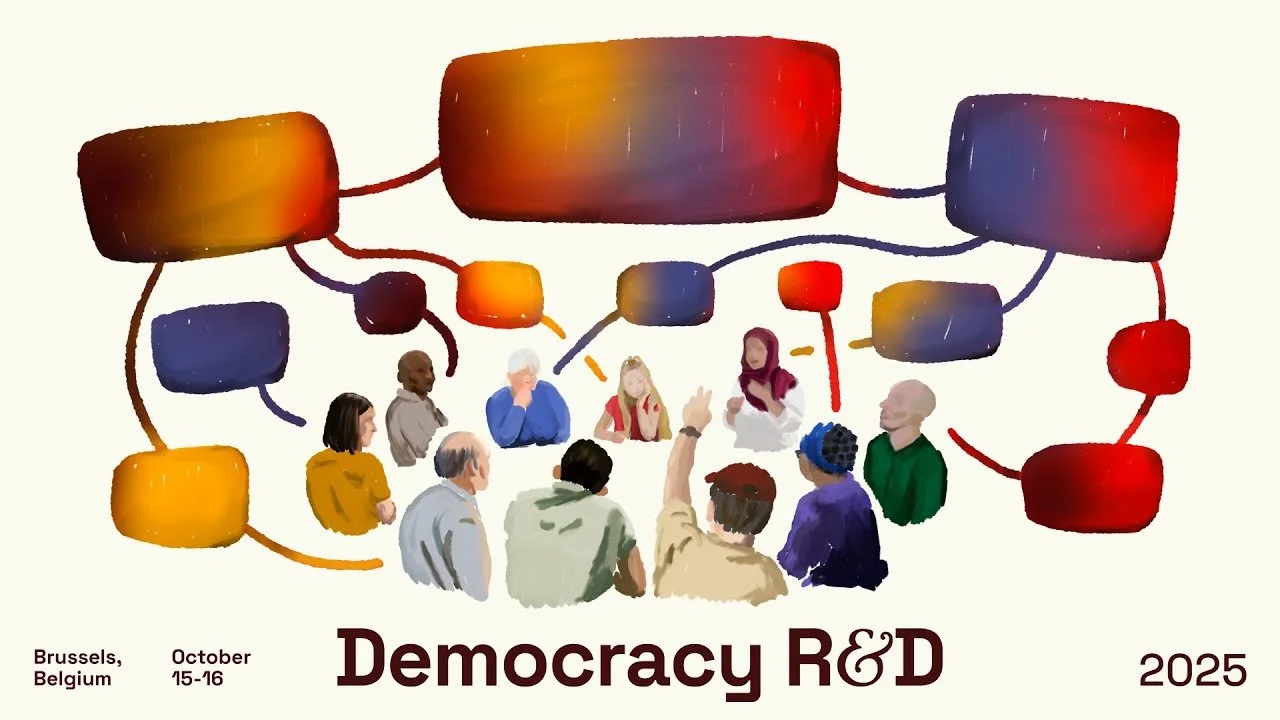
Democracy at a crossroads
A reflection of the moment our field finds itself in: navigating global polarisation, institutional inertia, and a surge of experimentation. It's a time to share breakthroughs, challenge assumptions, and ask: where do we go from here?
Belgium is a fitting host — not just geographically, but politically. With its pioneering work on permanent assemblies and institutionalized deliberation, the country offers fertile ground for these conversations.
Registrations and the Call for Workshop Proposals are now open!
The growing FIDE team
As our initiatives expand, so does our team! Over the last few months, three new colleagues have joined the Brussels office. They bring fresh perspectives, skills, and energy in these crucial times:
Kyle Redman joins us as our new Programme Manager, bringing with him years of experience designing and supporting citizens’ assemblies in Australia with the newDemocracy Foundation. He is a co-author of the United Nations Democracy Fund handbook ‘Enabling National Initiatives to Take Democracy Beyond Elections’ and the recently published book The A, B & C of Democracy. At FIDE, he is using these key insights to upgrade the support we provide to public administrations and practitioners across Europe.
Tamar Vashakidze joins the team as a Communications and Events Intern. With a background in anthropology and a strong interest in civic engagement, she’ll be supporting our editorial work, digital presence, and the coordination of the upcoming events, including the Spring School and Democracy R&D 2025.
Rubèn Llorens Poblador joins us as Research Intern. Trained in Political Science and Sociology, he has pursued his education between France and Spain and is currently completing his Master’s degree. In his role, he supports our Research Manager with new insights on permanent citizens’ assemblies and other key topics.
We’re thrilled to have them on board as we continue building structures for a more participatory democracy.
Until next time,
FIDE - Europe Team