
Telling the Past and Present Story of Deliberative Democracy in America
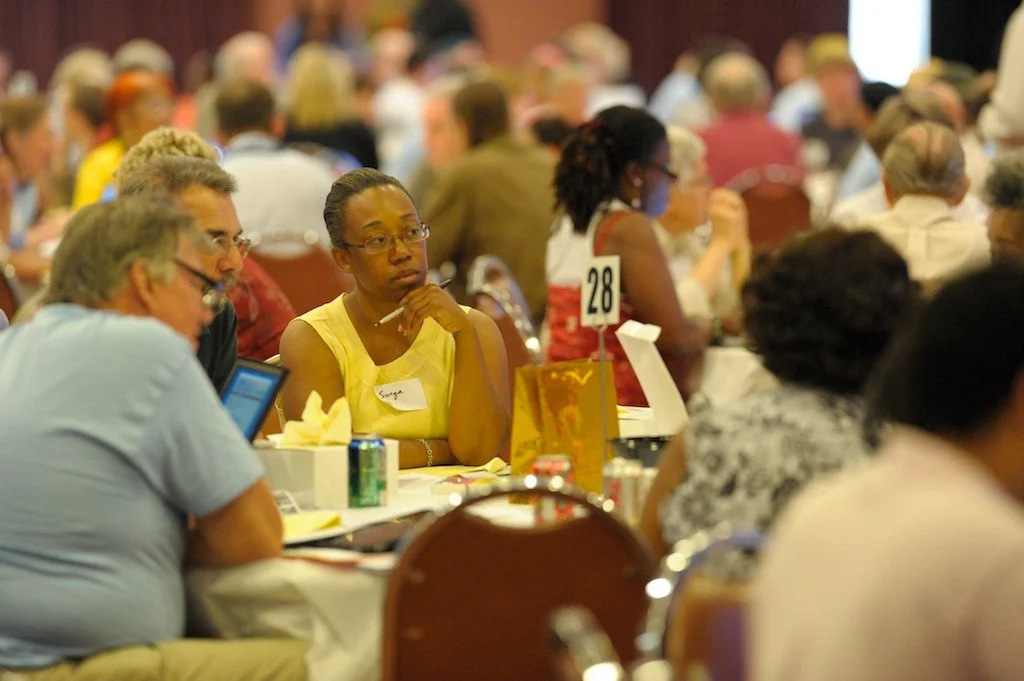
Americans deliberate at an AmericaSpeaks event in the 2006
FIDE - North America advances a democratic culture that is inclusive, responsive, deliberative and holds government accountable in between elections. Committed to a democratic process through narrative change, systems change and impactful citizens’ assemblies, FIDE – North America strengthens the deliberative community, advocates and raises awareness, provides technical guidance and builds capacity, develops independent case studies and best practices through a rigorous learning series. We hope you find this newsletter useful and informative. —Ansel Herz
July 4 was Independence Day. For this month’s newsletter, FIDE - North America steeps our discussion of Citizens’ Assemblies in the history and traditions of America. We then share, below, a new animated video explaining Citizens’ Assemblies produced in partnership with the Bertelsmann Stiftung.
So what is the story of deliberative democracy in America?
In the current moment, Europe dominates the picture: we often hear about Ireland, France, Belgium or Germany as leading in this area, with cutting-edge assemblies that enable citizen deliberation at scale.
However, our interviews with three renowned experts reveal a deeper and more complex truth. Europe is in the midst of a renaissance of democratic innovation, but it wasn’t so long ago that America seemed to be leading in this area, with deliberative exercises that filled convention halls and touched tens of thousands of lives. What we see is a “back and forth” trans-continental flow of deliberative ideas and practices across the Atlantic ocean and with the Global South, with different countries experimenting and borrowing from one another.
To dive deeply into this history, we spoke to three renowned experts: Jane Mansbridge, Harvard Professor of Political Leadership and Democratic Values, AmericaSpeaks Founder and President Carolyn Lukensmeyer, and Healthy Democracy Program Director Linn Davis. Rather than present their responses individually, we’ve weaved their interviews into a joint narrative tracing the history and initiatives that have influenced deliberative democracy in America today.
Early roots of deliberation in America
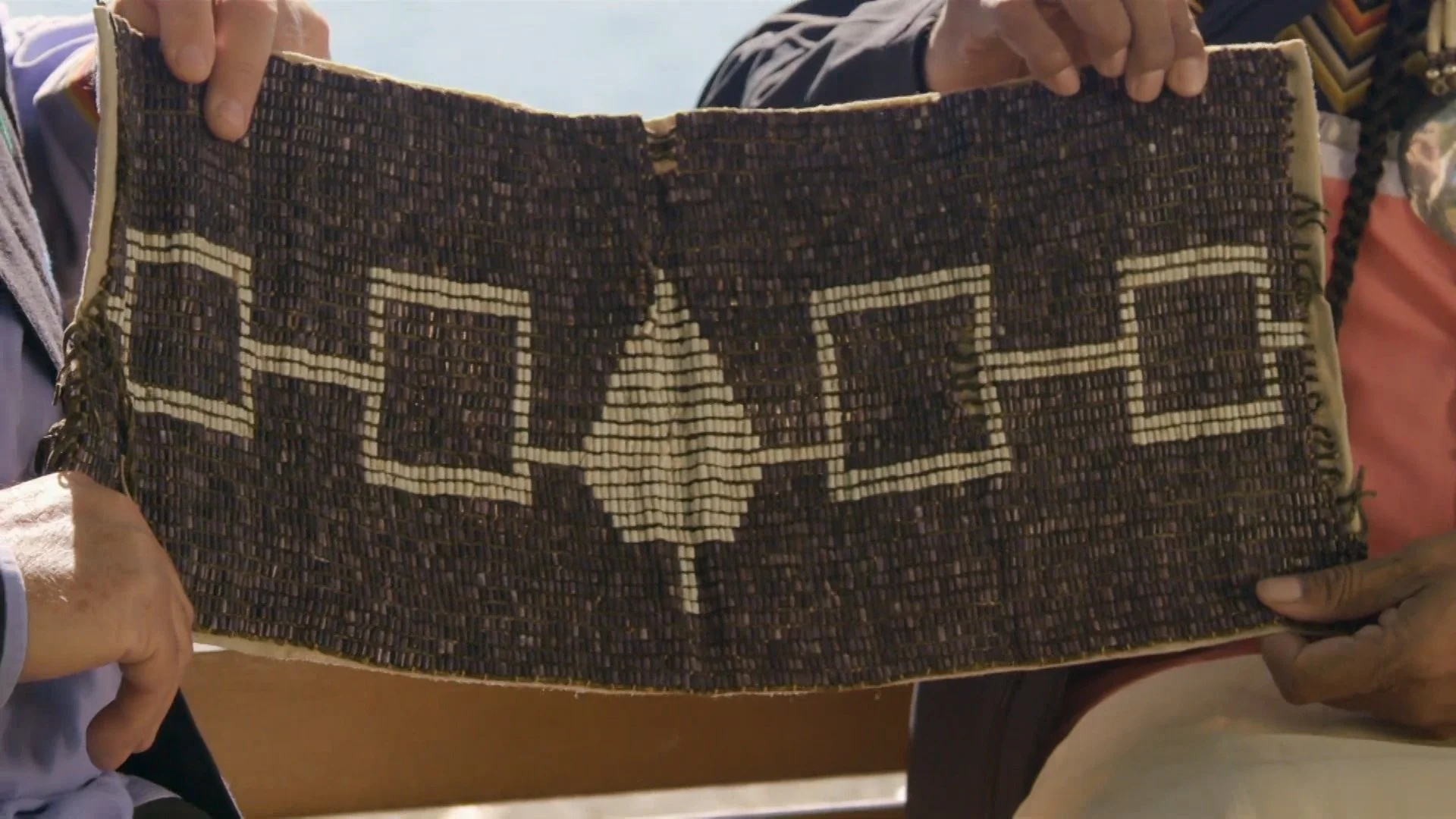
The American tradition of deliberative democracy arguably begins with the Iroquois Confederacy.
The Confederacy arose in the mid-1700s, linking six tribes of northeastern America and parts of Canada. It has been described as the “the oldest living participatory democracy on earth.” Two chiefs brokered an end to years of conflict between the tribes; they drew up an effective constitution for the Confederacy, known as the Great Law of Peace, which some historians argue directly inspired elements of America’s Constitution. Important decisions were made in group discussions, near “council fires,” until a consensus was reached. The bundle of 13 arrows held in the eagle’s talons in the United States seal was inspired by a Confederacy leader who urged the 13 colonies to unite against the British, in a speech that was later printed and distributed by Benjamin Franklin.
Before the Revolutionary War, anti-colonial activists formed Committees of Correspondence which used deliberative practices to coordinate acts of resistance. In Massachusetts, the Boston Committee of Correspondence hosted town meetings as a platform for their discussions; their 1772 pamphlet listing grievances against British policies came out of these meetings. The meetings allowed members to propose, discuss, and refine statements of colonial rights and grievances that all the participants could agree upon. The leading committees operated out of Massachusetts, Rhode Island, New York, Pennsylvania, Delaware, Maryland, Virginia, and North Carolina.
New England Town Hall meetings trace their lineage back to religious communities in Britain. Town hall meetings were used on both the putative left and right, in Quaker and Puritanical communities, as Davis points out.
These meetings were an area of special study for Mansbridge in her early academic career. “You had all the people gathering once a year, but also whenever there was an issue that needed to be settled,” Mansbridge said. “They would come to town, come to the church… and make those decisions themselves as a collective.” These meetings still happen to this day to decide things like local town or school budgets, but as state and federal governments have grown in power and complexity, some major issues can no longer be addressed at the local level, and the power of these town meetings has somewhat diminished, Mansbridge said.
Fits and starts
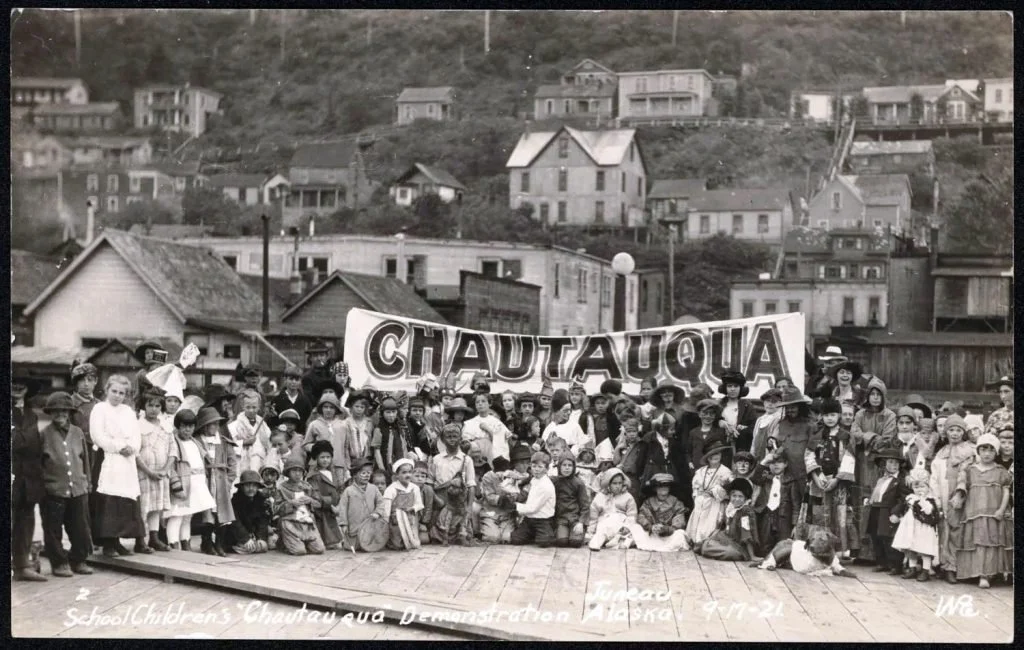
Just as the use of sortition itself has ebbed and flowed throughout world history, so too have deliberative practices over America’s history. It’s difficult to argue the deliberative spirit flourished after the American Revolution; the fledgling nation was too consumed by wars and divisions. Public forums such as lyceums and debating societies sprung up in some places.
During the Progressive Era, reformers like John Dewey championed a more participatory vision of democracy. The Chautauqua movement, named for a lake in New York, was a quasi-religious movement of more than 10,000 local assemblies throughout America in which lectures, popular education, and discussions of public issues were combined with concerts and plays. These were often held in rural towns and urban centers, serving an estimated 30-40 million people at its peak in 1924. Its founders sought to build civic bridges between regions; President Theodore Roosevelt described Chautauqua as the “most American thing in America.” But from the Civil War to the Jim Crow South to the Great Depression, America seemed too consumed by crises to make deliberative headway at an institutional level.
Post World War II — taking democracy for granted?
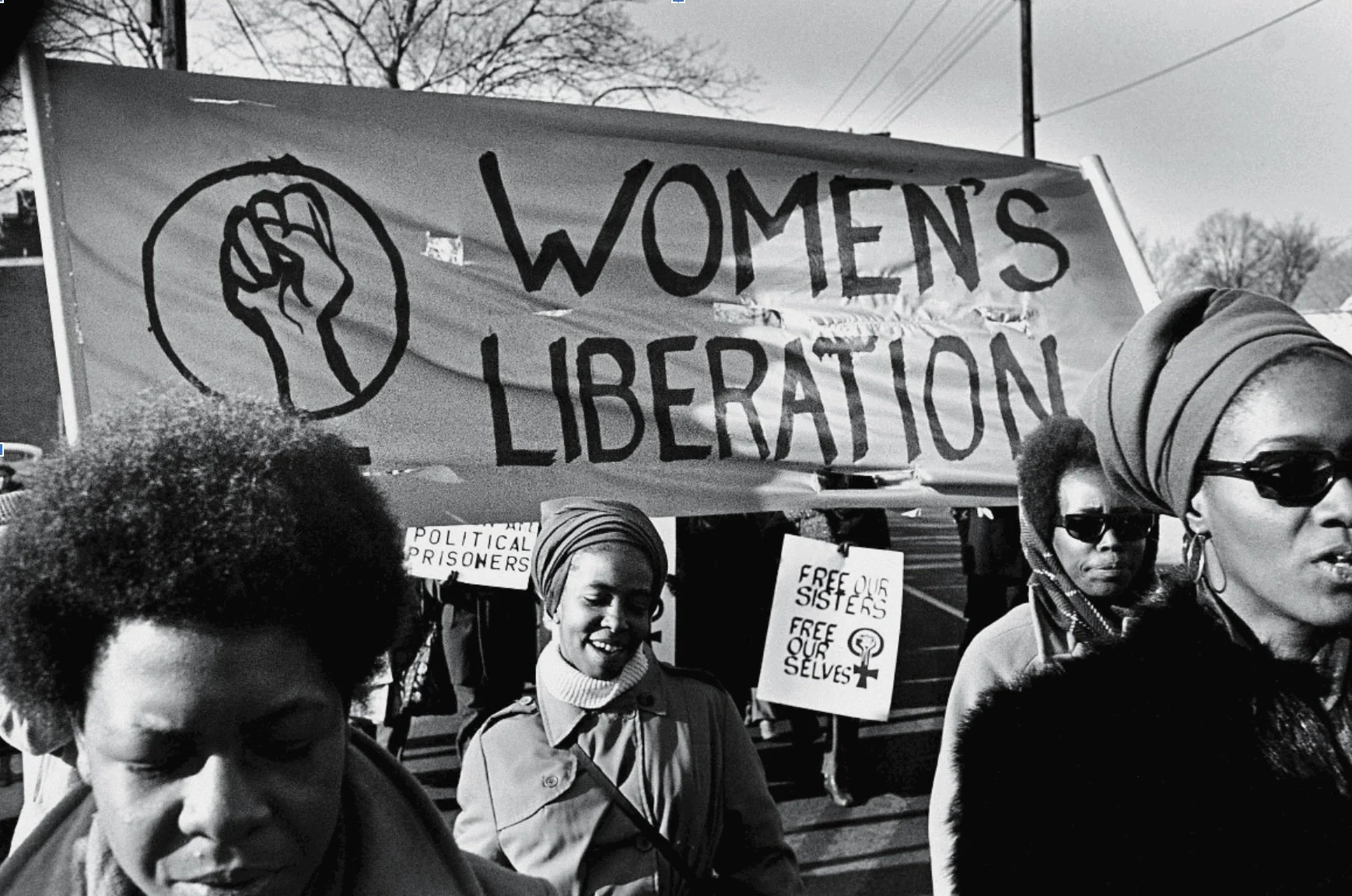
In our interviews, Mansbridge and Lukensmeyer agreed that after World War II, Americans became “complacent.” Unlike European counterparts such as Spain, Italy or Germany, who went in and out of democracy into dictatorships during the 20th century, by this time America had maintained its representative democracy for more than a century. Over two World Wars, it had marshalled its people, energy and resources to defeat autocracies.
“Somewhere along the line, maybe World War II… we decided our democracy was just great,” said Mansbridge. “We entered World War II, we fought the fascists. We, democracy, triumphed. And America was a democracy. End story. What more do we need to do?”
As Mansbridge herself discovered, there was more to do. Her own involvement in the field originates from her experience in the 1960s American feminist movement. Mansbridge noticed that women’s groups fighting for equality could not maintain a truly democratic internal ethos — similar, in a way, to how a two-year-old can’t help but throw a tantrum every now and then. Her insight was that you don’t blame the toddler for crying because it’s beyond their control.
Nor should one blame the women’s groups. What were the innately human dynamics that contributed to this inability to make democratic decisions? This thought process led her to write her first political theories.
Mansbridge performed two case studies — on a New England town meeting and a 41-person workplace — and began to “inductively” develop the ideas which would form the basis of her celebrated academic career. By 1980, she published the seminal “Beyond Adversary Democracy,” arguing that democracies “need to find ways to move fluidly between their moments of conflict [adversary democracy] and their moments of closer to common interests [unitary democracy], not letting the conflict drive out the commonality.”
Around this same time, Linn Davis’ mother was involved in a group called the Movement for a New Society, founded in 1971.
“They were at least partially responsible for the popularization of iterative small-to-large group processes and mechanics that are 100 percent the basis of deliberative democracy,” Davis said.
The Movement grew out of Quaker resistance to the Vietnam War and into a national network, with more than 100 members in Philadelphia alone. According to one research paper, the group effectively “popularized consensus decision making,” and Davis described how “they would go talk to activist groups and sort of mediate between groups and show them how to organize themselves.”
A powerful idea is sparked in two places, simultaneously
That same year, in 1971, a political scientist named Ned Crosby published his doctoral dissertation on social ethics, in which he developed the idea of a Citizens’ Jury. Almost simultaneously, a German sociologist Peter Dienel struck on virtually the same idea — the two would not learn about each other until almost a decade later, after performing research on dozens of juries and panels which they assembled. In a 1986 paper, Crosby called for giving
“serious and systematic attention to possibilities that may initially seem realistic, such as... creating randomly selected citizen assemblies... to analyze policy and make recommendations."
When Crosby passed away in 2022, Healthy Democracy’s Robin Teater wrote, “Ned was perhaps a man ahead of his time.” Crosby’s work was a major inspiration for what became the Citizens’ Initiative Review in Oregon, which we explore in detail below.
“If Ned Crosby’s life teaches nothing else, let it be this. However unlikely something may be, if it is possible, it can be achieved. May it ever be so for those things our world needs most.”
- John Gastil, Penn State University Professor
The 90s and early 2000s: a resurgence of American deliberation
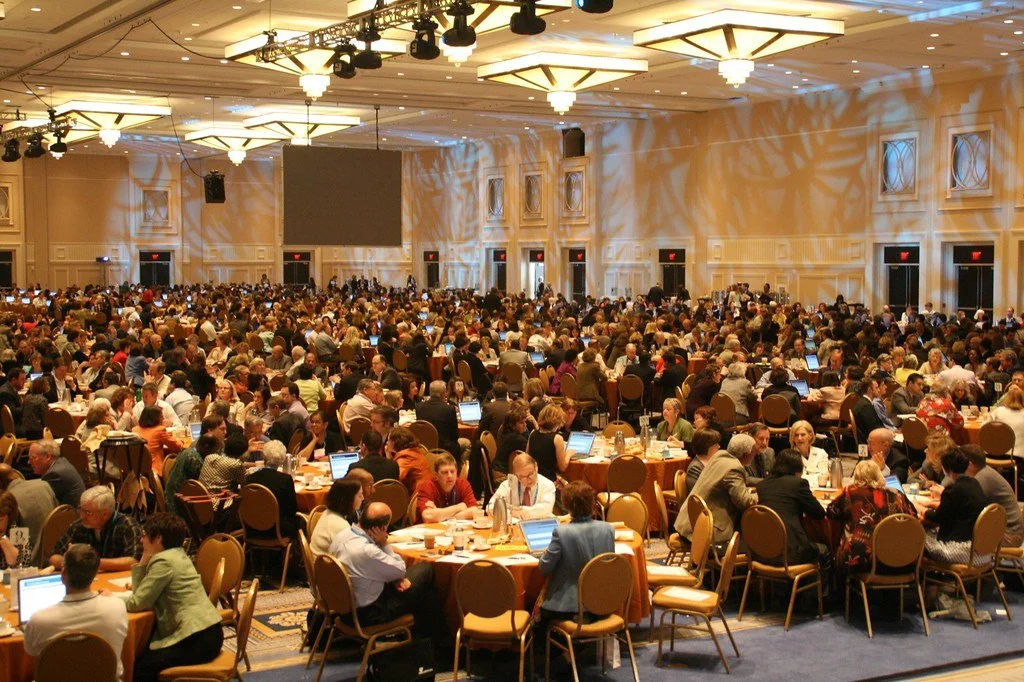
According to Carolyn Lukensmeyer, founder of AmericaSpeaks, America was closer to the forefront of innovation in deliberative democracy from roughly 1990-2010 — and Davis tends to agree. She is happy to see a steady resurgence taking place in America now.
A vision came to Lukensmeyer in 1994, after influential stints in state government and the Clinton White House. “I was given the gift of a literal vision in my mind's eye. What I saw was a map of the United States, 10 cities geographically dispersed as much as possible with a thousand Americans sitting in each one of those 10 cities, having a discussion on a major public policy issue.” She also imagined Peter Jennings on national television, saying, “Today, 10,000 people spent the day dialoguing on what we should do about social security… and this is what they said.”
Lukensmeyer secured an initial tranche of $50,000 in funding from the Rockefeller Foundation and tried to connect her vision to decision-makers in government. “We never did a project unless the people who had the power to do something about it were committed,” she said.
Thus, AmericaSpeaks was founded in 1995 and according to Lukensmeyer, the organization engaged more than 165,000 people in all 50 states in large-scale citizen participation on a range of issues; the rebuilding of post-Katrina New Orleans; statewide health care reform in California; the national childhood obesity epidemic; the need for effective services for adolescents and adults with autism; and strategies for ensuring a sustainable fiscal future.
Lukensmeyer said these deliberations had an impact. In one example, AmericaSpeaks convened 4,300 New Yorkers to deliberate on the rebuilding of Ground Zero following the September 11 attacks. After a day of “tough” discussions, participants were unimpressed with the city’s plans; officials withdrew and revised them.
AmericaSpeaks’ other notable achievement was the creation of a network of more than 5,000 skilled facilitators, which civic groups around the country could utilize as a resource. The group also helped to spur progress on related democratic innovations such as participatory budgeting as far back as 1999. AmericaSpeaks closed in 2014, Lukensmeyer said, because of the Great Recession and lack of funding.
Meanwhile, in the forested hills of Oregon, Crosby’s ideas found a home with two graduate students, Elliot Shuford and Tyrone Reitman, who were concerned about the outsize influence of big money on statewide ballot measures.
Crosby’s nonprofit, the Jefferson Center, had run dozens of citizens’ juries over the years from Minnesota to Pennsylvania, as well as two national juries in 1993. In some of these examples, “candidates for a political office were evaluated by a cross-section of a representative's selection of the public to produce voter information for voters around these candidates,” Davis recalled. But this ran into opposition from the IRS, so the focus shifted away from candidates.
The two graduate students traveled all over the state in a cargo van lobbying for a statewide Citizens’ Jury process that would produce voter statements on ballot referendums. Remarkably, their proposition became law in 2011 on a bipartisan basis.
The CIR model has since expanded into four other states as pilot projects, including in Arizona and Massachusetts. But in Oregon, because it relies on private funding which has run dry, the CIR has been on hiatus since 2016.
What next in the American story?
Davis agrees with Lukensmeyer that America was leading in a more robust way on deliberative innovations until recently. “Then, there was a period where I think we kind of stagnated… we got a little bit too static, not as revolutionary,” he reflected.
From the 2010s onward, the Ostbelgien model, national assemblies in France and Ireland, and the work of groups like the G1000 and the Federation for Innovation in Democracy (FIDE) have pushed the field forward. Davis remembers one of his predecessors at Healthy Democracy visiting Barcelona to observe a citizens’ assembly and saying, “They’re doing these things that we’ve never even thought of!”
Still, Davis argues, there are some uniquely American deliberative qualities that may yet inspire the Europeans. He believes Healthy Democracy has significantly improved upon Crosby’s original Citizens Jury model by placing more agency in the hands of the citizen-members.
“To us, Europe looks very technocratic and not as democratic in some cases… we are trying to now push back to say… the assembly should be at the center of its universe.”
Davis believes “there needs to be total democracy throughout the system from the cradle to the grave, with the assembly as much in control of both the content and process as possible and always in control of what it’s doing.”
This emphasis on the assembly members’ autonomy is both an iteration on the original Citizens’ Jury model and was inspired, in turn, by the citizens’ agenda-setting role in examples such as Ostbelgien, Belgium.
Lukensmeyer issued a powerful rallying cry for another deliberative wave in America. “The vast majority of Americans do actually want to do something,” she said,” but they've lost an understanding of any actions they can take to positively impact the situation that we are in… Right now is a time that anyone working in a deliberative democracy strategy needs to keep this in mind. The public is ready for this work.”
For Davis, Lukensmeyer and Mansbridge, this work is personal. As Mansbridge said in an interview with the Harvard Gazette, her father “left England — a country he loved, because he hated its class system. He passed on to his children his love for American egalitarian ideals.”
Davis sees a special attentiveness in Americans to power differentials that he doesn’t always see in Europe.
“The ethos of radical self-determination is certainly a thread throughout the American experience and it crosses political lines,” he reflected. “I do think we have a really quality aspect in our culture of a kind of rebelliousness that hopefully will bring us back from the brink of authoritarianism.”
In other words, this story is far from over. The history of deliberative democracy in America is a story of aspiration and limitation. From the Iroquois Confederacy’s consensus-driven councils to New England town meetings and modern citizens’ assemblies, Americans have sought to co-govern collaboratively through dialogue and reason. Yet, exclusion, polarization, and lack of government accountability have often constrained these efforts.
As the country faces new technological and political challenges, the moment seems ripe for government-championed citizens’ assemblies as a tonic to rebuild trust and unity. FIDE - North America - alongside peer organizations, government champions, and ordinary citizens interested in change - is part of these efforts. Our efforts should focus on respect for democratic process and institutional reform so as to avoid the pitfalls of the past. As we spread this message, we hope the video in the following section is an interesting and fun introduction to this innovative approach. Success will depend on expanding access, demonstrating impact, and cultivating a culture where policy reforms align more closely with citizen preferences in between elections—honoring the spirit of earlier deliberative models while moving toward innovations such as citizens’ assemblies.
New Citizens’ Assemblies video - share widely!
The Bertelsmann Foundation and FIDE - North America have partnered to create a 5-minute explainer on how Citizens’ Assemblies work. The animated video is meant as a fun introduction to the concept for American audiences.
Upcoming Webinar: Democracy Beyond Elections - Citizens’ Assemblies and Institutional Reform
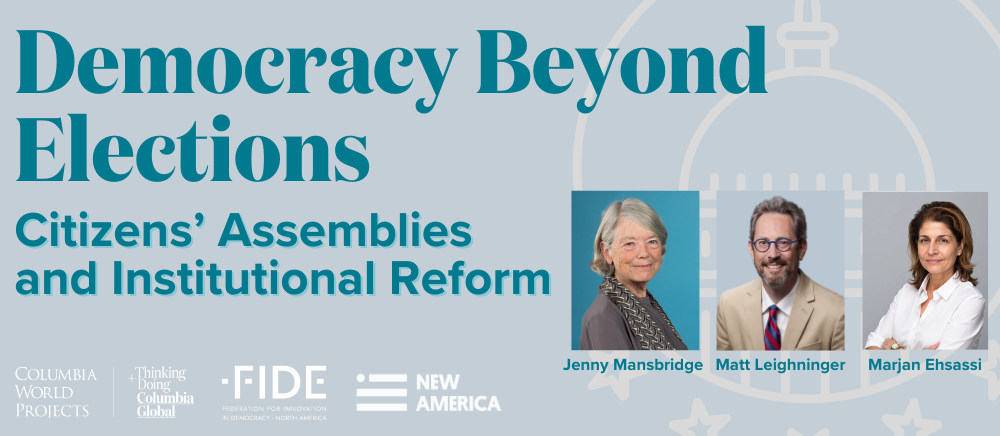
The U.S. has a surprising history of deliberative democracy—from bold experiments in sortition to grassroots-led reforms. Most failed to take root. Citizens' Assemblies - such as those in Bend and Boulder - are part of deliberative democracy’s latest comeback.
Columbia World Projects, New America’s Political Reform program, and FIDE - North America invite you to join us for a webinar on Thursday, September 18th from 11:00 a.m. to 12:00 p.m. EST, exploring the past, present, and future of assemblies in America, and their role in broader institutional reform movements. Alongside leading democracy scholars and changemakers, we’ll look at what worked, what didn’t, and how today’s efforts at every level of government are reshaping the movement for a more inclusive and responsive democracy.
Speakers:
-Jenny Mansbridge, Adams Professor of Political Leadership and Democratic Values Emerita, Harvard Kennedy School
-Matt Leighninger, Director, Center for Democracy Innovation, National Civic League
Moderator:
-Marjan Ehsassi, Executive Director of FIDE - North America
This event is part of an ongoing series in collaboration with New America and FIDE - North America exploring the opportunities and challenges of using citizens’ assemblies in the United States. These virtual discussions bring together leading researchers and practitioners to offer valuable insights for students, civic leaders, and anyone interested in the future of democratic innovation.
Innovation Fellow Announcement
FIDE- North America is recruiting a part-time Innovation Fellow to work with us this Fall! We’re looking for someone interested in governance reform, skilled in communications and social media, and with the ability to support our programs and research if needed.
The anticipated start date is Monday, September 8. Fellows will be paid $20 per hour and are expected to work 6-8 hours a week. This is a hybrid position based in Washington, DC.
Join our network
North America is a big place! Are you active in the space of deliberative democracy, or interested in bringing citizens’ assemblies to your community? Contact us at north.america@fidemocracy.org to let us know about your work and your goals.
Interested in contributing to the future of democracy? Contact us if you’d like to join a team of volunteers who are helping support FIDE’s programs.
We hope to see you at an event, whether in-person or virtual! For more, follow us on LinkedIn or join us over at our new account on Bluesky.
Until next time,
The FIDE - North America Team