
FIDE - North America Launches Cross-Partisan Citizens’ Assembly Program for Governors and State Officials
As democratic institutions across the United States confront declining trust, deep polarization, and complex policy challenges, FIDE - North America is launching a groundbreaking program to help state leaders across America explore a proven approach to strengthening democracy and public engagement: citizens’ assemblies.
The Deliberative State Governance (DSG) program will bring together Governors, Secretaries of State, and senior state officials from across the country to learn firsthand how deliberative democratic processes can increase civic health and bolster legitimacy for public policies.
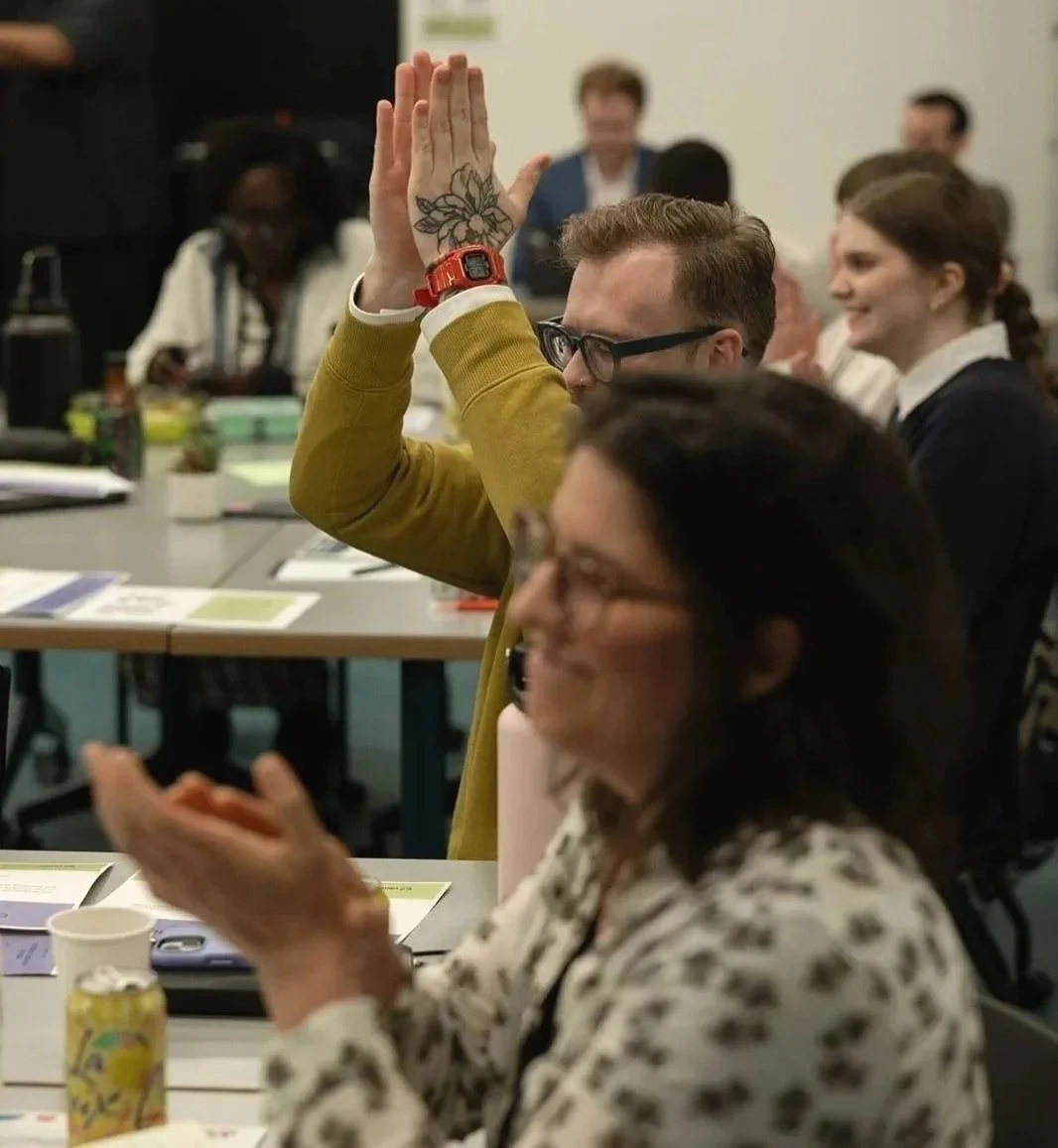
Helping state-level decision makers understand how deliberative processes work — and how they can be implemented to collectively solve public problems — is key to the successful scaling of deliberative processes. While citizens’ assemblies have gained momentum at the municipal level, including Dayton, Akron, Lexington, Bend, Petaluma and more, DSG is designed to address a gap at the state level.
“DSG is an incredible opportunity for state principals to learn about the impact and efficacy of citizens’ assemblies and deliberative democracy through workshops, convenings, and exchanges with international elected officials,” said Kara Revel Jarzynski, FIDE - North America’s Strategic Director for Deliberative State Governance. “Designing deliberative processes where citizen voice is heard, considered, and folded into policy is a key step forward for civic health and trust,” Jarzynski said.
Public Support for Strengthening Democracy
Americans are hungry to have a voice will reward those who listen.
According to the University of Maryland Demand for Public Consultation, 79 percent of Democrats and 64 percent of Republicans would switch party affiliation if the other candidate pledged to consult more with constituents.
Having a sense of consequential voice through fair, informed, representative deliberative platforms increases public trust by 47 points. Deliberative democratic processes address rising voice insecurity and meet the public demand for increased trust and agency. State governments wield enormous influence, spending $1.8 trillion annually on direct services including schools, infrastructure and more. While public trust in state government is generally higher than trust in the federal government, in recent years even state-level trust faces pressure from high levels of political polarization. By joining the DSG, state governments will learn how to reverse these trends, reinvigorate communities, and solve thorny policy problems.
2026 DSG Program Details
The DSG program is intentionally small and cross-partisan. DSG’s first convening will take place on the heels of the National Governors Association’s Winter Meeting in February 2026, where participants will receive what Jarzynski described as a “compact, highly effective ‘citizens’ assembly school,” modeled on FIDE - North America’s highly successful Learning Series.
The agenda centers on real-world case studies, including Ireland’s internationally recognized citizens’ assemblies. “Ireland is about the same size as many American states,” Jarzyinski pointed out, “which makes it a really strong case study for how assemblies can actually work at scale.”
Further programming, designed to be shared between Governors, Secretaries, and their senior staff, is scheduled for the Spring/Summer in Brussels; and the Fall/Winter, back in the U.S. These gatherings will bring Citizens’ Assemblies to life by bearing witness to deliberative processes in action both abroad and here at home.
Across each event, American governors and senior officials will have the opportunity to exchange with international electeds and deliberative democracy pioneers from the European Commission, French CESE, Belgian Parliament, and Canadian Parliament.
DSG is advised by a robust Council of nationally and internationally respected governance, technology, and philanthropic leaders (see below).
“Institutionalizing deliberative governance matters more than ever, said DSG Advisory Council member Kris Rose, Global Head of AI Governance at IBM. “I’m honored to support FIDE - North America as it introduces a group of distinguished state leaders to the power of Citizens’ Assemblies, giving them a firsthand look at how deliberation delivers tangible, meaningful impact for communities and policymakers.”
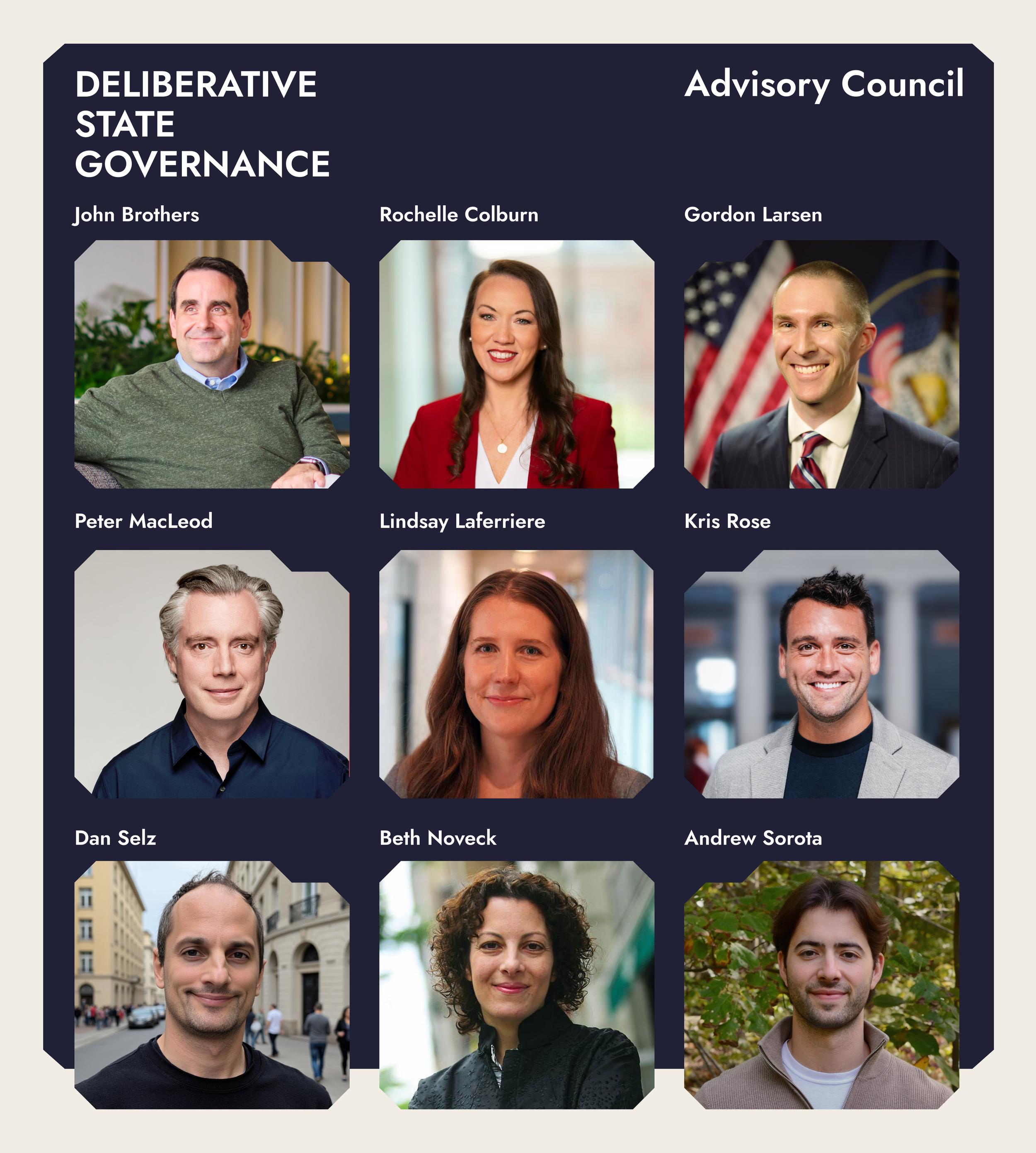
The Advisory Council includes:
1. John Brothers, President & CEO, Charles and Margary Barancik Foundation, former President,T. Rowe Price Foundation & T. Rowe Price Charitable
2. Rochelle Colburn, COO, Future Caucus
3. Gordon Larsen, Vice President, 50 State; former Senior Advisor for Federal Affairs, Governor Spencer Cox, UT
4. Peter MacLeod, Principal, MASS LBP
5. Lindsay Laferriere, Director, Rebuilding Trust in Government, Partnership for Public Service
6. Kris Rose, Global Head of AI Governance, IBM; former Governance Director, Meta
7. Dan Selz, CEO, $1 Billion for Trust
8. Beth Noveck, Professor, Northeastern University; Director, The Burnes Center for Social Change and The Governance Lab; Chief AI Strategist, State of New Jersey; former United States Deputy Chief Technology Officer under President Obama
9. Andrew Sorota, Head of Research, Office of Eric Schmidt
“Citizens' assemblies are a promising tool for building trust between governments and the public they serve. I am excited to be part of this effort to expand the use of citizens' assemblies in the United States and seize the opportunity they create for strengthening our democracy.” Lindsay Laferriere
Building on Precedent from Washington State
Washington is one of the states currently leading the charge on deliberative practices. In 2024, recognizing the need for greater input from working class people on state economic, environmental and health policy, the Washington's Economic Justice Alliance partnered with Just Futures – a statewide coalition of frontline communities – to hold six community assemblies around the state.
In these issue-driven assemblies, frontline community members (ranging from union workers, to agricultural workers, to rural communities) deliberated in group sessions to formulate policy, program or funding recommendations for local or state officials, depending on what the need was for that community.
“[Typical] listening sessions are often episodic and transactional. They don’t give people the opportunity to understand the pathways to decision-making,” said Faduma Fido, a lab leader at People’s Economy Lab, who helped organize some of the sessions. She said the community assemblies helped burst the bubble of insulated bureaucracy, creating greater “shared ownership” of key economic, climate and energy policies between government and community members.
“We listened to firefighters talk about the toxins they inhale responding to wildfires, and the effects that follow them long after they leave the job,” Fido explained. “Postal workers shared stories of co-workers dying in vehicles that weren’t insulated against heat waves… These weren’t abstract conversations. They were about how climate conditions affect people’s health, their work, and their families.”
The community assemblies deliberately did not use a lottery system to select participants and therefore did not meet FIDE - North America’s definition of Citizens’ Assemblies or the OECD Guidelines; instead, workers who were considered highly vulnerable to climate and economic impacts were selected. Washington officials said the initiative was successful given the short amount of time given to do the community assembly pilots, marking a promising first step toward an expanded assemblies program.
“The assemblies are a promising approach – participants reported feeling that their voice actually mattered and that their trust in government grew,” said Lori Pfingst, Senior Director of Economic Justice at Washington State Department of Social and Health Services. “There was a sense of agency that came from participating in the assemblies… we're investing in the infrastructure to create that connective tissue across the state.”
“Connective tissue,” Jarzynski adds, “includes space between citizens and policy – and between citizens and electeds. It’s why DSG is critical to the successful scaling of deliberative models at local and larger-scale models.”
For more details on Washington’s community assemblies, see the Just Futures Washington 2024 Community Assemblies report.
DSG Objectives and Outcomes
Participants in FIDE - North America’s DSG will hear firsthand from those who have implemented highly successful citizens’ assemblies around the world — what worked, what didn’t, and, most importantly, the impact.
Seeing these models in action will be critical if states are going to design processes that are credible and effective. DSG’s programming in 2026 will set the stage for states to move forward with statewide citizens’ assemblies and/or to support local assemblies beginning in 2027.
“We want this educational component to come full circle: to have real legs, and to become an effective tool at the state level,” Jarzynski explained. “Even if a state chooses not to launch an assembly, the fact that senior officials understand how these processes work is incredibly important to building supportive infrastructures at different levels.”
We believe that informed leadership among state governors and officials is a necessary prerequisite for democratic innovations that can meet the grave challenges of today’s public landscape.
To learn more about FIDE - North America Deliberative State Governance (DSG), read more on the DSG website.
To learn more about FIDE - North America’s Capacity Building Schools, read more on our webpage!
UPCOMING EVENTS
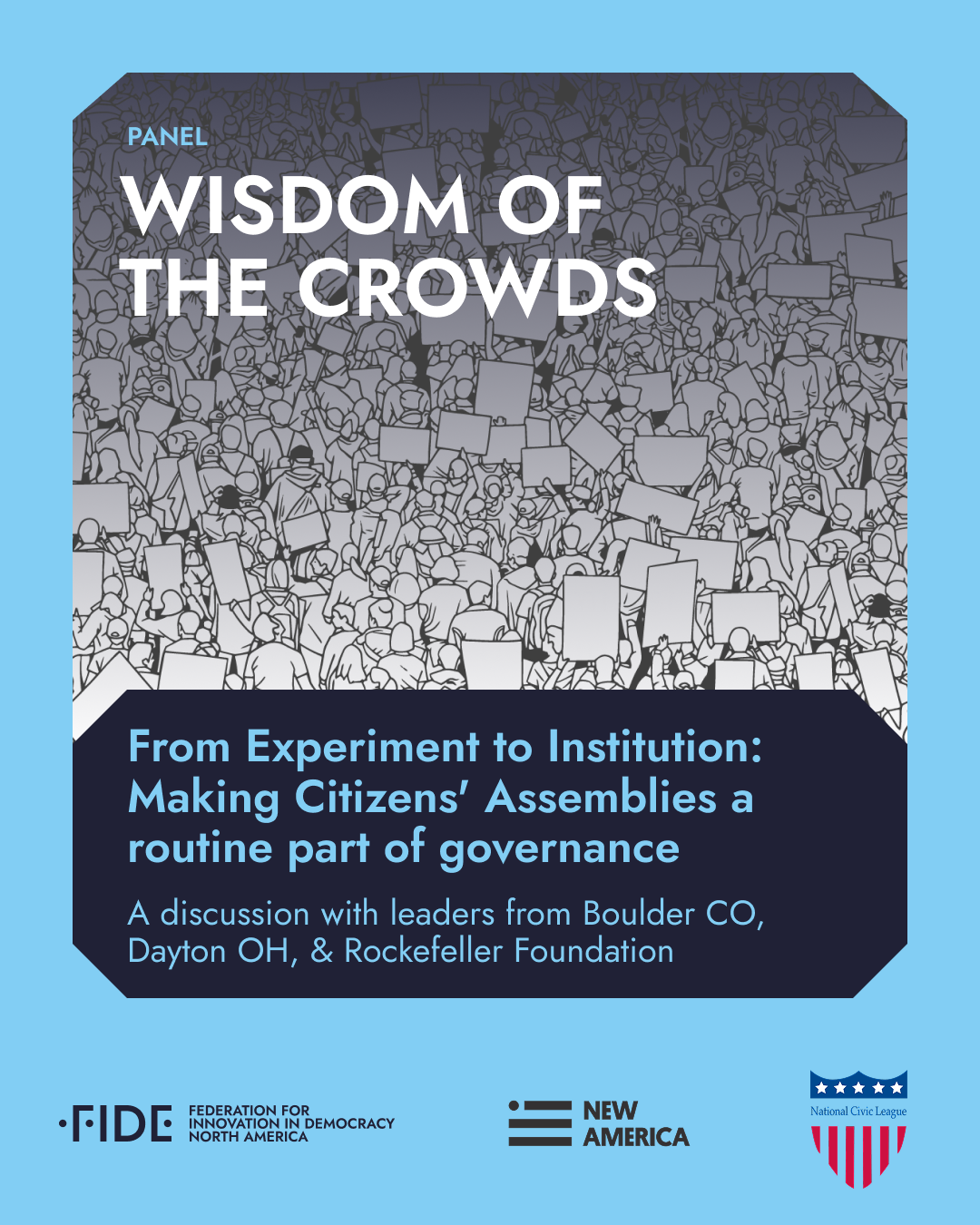
This public event explores how governments can meaningfully absorb and act on assemblies’ recommendations, examining the benefits, risks, and institutional structures needed to make recurring assemblies possible in the U.S.
When: Jan. 15, 2026. 4:00 pm - 6:00 pm
Where: New America, 740 15th St NW #900 Washington, DC 20005
Hosted by FIDE North America, National Civic League, and New America , with leaders from the cities of Boulder and Dayton, and the Rockefeller Foundation.
This event is in person only, and open to the public subject to registration.
The event will be held on the sidelines of FIDE - North America’s convening of implementers from the US and Canada for a day of closed-door discussion.