
Lessons from Hungary: Countering Authoritarianism with Citizens’ Assemblies
In this edition of our newsletter, we speak with Eva Bordos, director of DemNet, an independent NGO in Hungary and FIDE - Europe Board Member. She is an Eisenhower Global Fellow and a Distinguished Visiting Fellow at the Perry World House at the University of Pennsylvania (2025–26).
We began by discussing a recent citizens’ assembly in Ukraine.

Eva Bordos: The Ukraine assembly, supported by the Council of Europe, was one of the most memorable experiences of my career—seeing deliberative democracy take root under extremely difficult conditions. The processes were held in two municipalities, and in one of them, half of the meetings happened in a shelter because of air-raid alerts. People moved into the shelter to deliberate, which I found very powerful.
How many assemblies have you been involved with?
E.B.: We started working on deliberative democracy in 2017 through an EU-funded project. At the time we hoped it might eventually counter democratic backsliding, even though, for the first two or three years, everything stayed quite theoretical. Our first pilot citizens’ assembly took place in Budapest in 2020, and four or five more followed. Altogether I’ve designed or coordinated six assemblies in Hungary, plus two in Ukraine. Right now I’m designing Tirana’s first-ever citizens’ assembly—a climate youth assembly planned for early next year, initiated by the OSCE. And I also served on the oversight committee of Belgium’s National Citizens’ Assembly on AI. Beyond that, I’ve observed many assemblies across Europe and visited the Fort Collins Assembly in the U.S.
So you’ve been at this for nearly a decade. What trends have you seen?
E.B.: Assemblies are definitely becoming better known across Europe, and more decision-makers are willing to take the calculated risk of consulting citizens. But deliberative democracy is evolving at two very different speeds. Western Europe is driving the “deliberative wave,” while Central and Eastern Europe lag behind. Only a handful of countries in this region have experimented with full-scale assemblies that meet OECD and Council of Europe standards.
This gap has deep roots. Civic engagement is lower because of our historical legacy. Many people—like my 92-year-old grandmother—still believe public affairs are something you should stay out of.
Polarization and fragmentation make everything harder. But despite that, I still believe deliberation is one of the most promising democratic tools we have.
Most of your assemblies have taken place at the local level. Why have cities taken this step?
E.B.: In countries where civic space is more closed, cities often become the last small bastions of democracy. After Hungary’s 2019 local elections, several major cities elected opposition or independent mayors. In response, the central government redirected locally collected taxes—officially under the banner of COVID “solidarity”—but the real effect was to weaken the cities financially.
With fewer resources for major projects, many mayors felt they had to show a different kind of governance: more open, transparent, and participatory. So they turned to participatory tools, including deliberative ones, out of both necessity and conviction.
All our assemblies used two-stage random selection with demographic filters—age, gender, education, geography—and we kept dropout rates low by selecting substitutes. Most assemblies ran four or five full days and, while smaller-scale than national processes, fully met international standards. Topics included climate, mobility, air pollution, and Hungary’s first-ever women’s citizens’ assembly, which we ran in two Budapest districts to explore how municipal services and city safety could better serve women.
What happens afterward? Do recommendations get implemented?
E.B.: It really depends on how you define success. Some of my Western European colleagues focus almost exclusively on policy change. But here, societal impact is just as important.
If participants leave feeling more empowered and more trusting—of each other and of decision-makers—that alone is a significant achievement.
Follow-through varies. In one city, the mayor who supported participatory processes lost the next election, and the new leadership didn’t prioritize implementation, so momentum slowed. In others, we’ve seen meaningful steps toward adoption, although not all recommendations are implemented yet. These processes are only a few years old, so expectations need to be realistic.
One participant even ran for office afterward—ironically joining a radical right-wing party. To me, that simply shows our recruitment worked: we attracted people from across the political spectrum, not just green or left-leaning citizens.
What are the biggest challenges—recruitment, political buy-in, budget?
E.B.: First is our historical legacy. Under socialism, politics was something done to people, not with them. That mindset persists today, both among citizens and within public administrations, where people are still often treated as clients or subjects rather than partners.
Second is trust—both vertical and horizontal. In a public survey we ran, most respondents said citizens’ assemblies weren’t feasible in Hungary. They believed politicians would never host them and that their fellow citizens wouldn’t participate. But when asked if they themselves would participate, most said yes—they just didn’t trust that others would.
Third is funding. Public-sector innovation is slow, and there’s sensitivity around how public money is spent. Our first four assemblies were possible because donors were willing to invest. Cities co-financed them, which also helped build trust. But in our two most recent cases—the two women’s assemblies—the districts financed the entire processes themselves. That’s a major milestone and shows growing confidence in the model.
What other developments have you noticed recently?
There’s definitely more awareness now, but something else is happening: people are increasingly demanding honest and respectful dialogue. Political actors have tried to deepen polarization, but people are exhausted. You can’t fuel division forever without consequences. I think we’re approaching a tipping point.
Young people especially—those under 30 or 40—have seen how engagement works elsewhere, they travel, they speak languages, and they take inequalities seriously. They are very open to deliberative processes.
In the United States, we’ve seen partisanship virtually vanish among assembly members.
E.B.: Exactly.
Once people start focusing on the issue, differences can be overcome. No matter which party someone votes for, they’re still a human being.
Deliberation is powerful in that way. It’s also harder for authoritarians to attack. They can discredit intermediaries—media, NGOs—but directly attacking the people themselves is risky. If the process is transparent, fair, and balanced, attempts to delegitimize it don’t stick.
How have national political actors responded? Do they see assemblies as a threat?
E.B.: Mostly through silence. Some national leaders probably know about these processes; others may not. In one city, a former mayor publicly accused us of mishandling personal data and serving the interests of the current mayor. We responded by becoming fully—almost excessively—transparent, communicating every step in detail. Despite the controversy, we maintained a standard 3% registration rate.
My colleague and I are also writing an article about a specific barrier we encountered. Cities need a legal basis to request a random sample of residents from the national citizen registry. For our first four assemblies, the ministry provided this data. But last year, they denied the request, citing a supposed legal issue with the municipal decree. It was obvious the denial was political. We don’t know whether it came from high-level instruction or simply a cautious bureaucrat, but it forced us to change our recruitment method and added a new administrative hurdle.
Do you see a pathway to national-level assemblies in the region?
E.B.: Earlier this year in Poland, there was a deliberative mini-public initiated by an NGO with backing from a ministry. It involved 32 high school students, so was smaller in size , but it was still a positive sign. We’re waiting for a government in the region to take the next step and commission a national-level assembly.Until then, local assemblies remain crucial. They build skills, develop institutional capacity, and demonstrate what works in practice before scaling up.
What lessons flow between regions? What can Eastern and Western Europe learn from each other?
E.B.: The international knowledge exchange is invaluable—there’s a very supportive global community. And one thing is essential everywhere: maintaining minimum quality standards. If the term “citizens’ assembly” starts being applied to every deliberative process, you dilute its meaning and undermine public trust. Then, when you need the method for major questions—like constitutional reforms—the legitimacy won’t be there.
I am on the Board of FIDE - Europe and am enthusiastic about the contributions it and FIDE - North America have made to strengthen the deliberative community. FIDE - North America’s initiatives to develop definitions, standards, a theory of change, as well as their Learning Series, a growing body of Citizens’ Assembly case studies and independent evaluations generating comparative data and best practices are critical for the success of our collective work.
When I was in the U.S., someone asked whether they should focus on local- or national-level assemblies. I said both matter, but don’t underestimate the power of multiple local processes—and in the U.S., state-level processes as well. I’m especially inspired by the work happening in Los Angeles on the city charter, Boulder and Dayton to name a few and hope to bring lessons learned back to Central Europe!
UPCOMING EVENTS
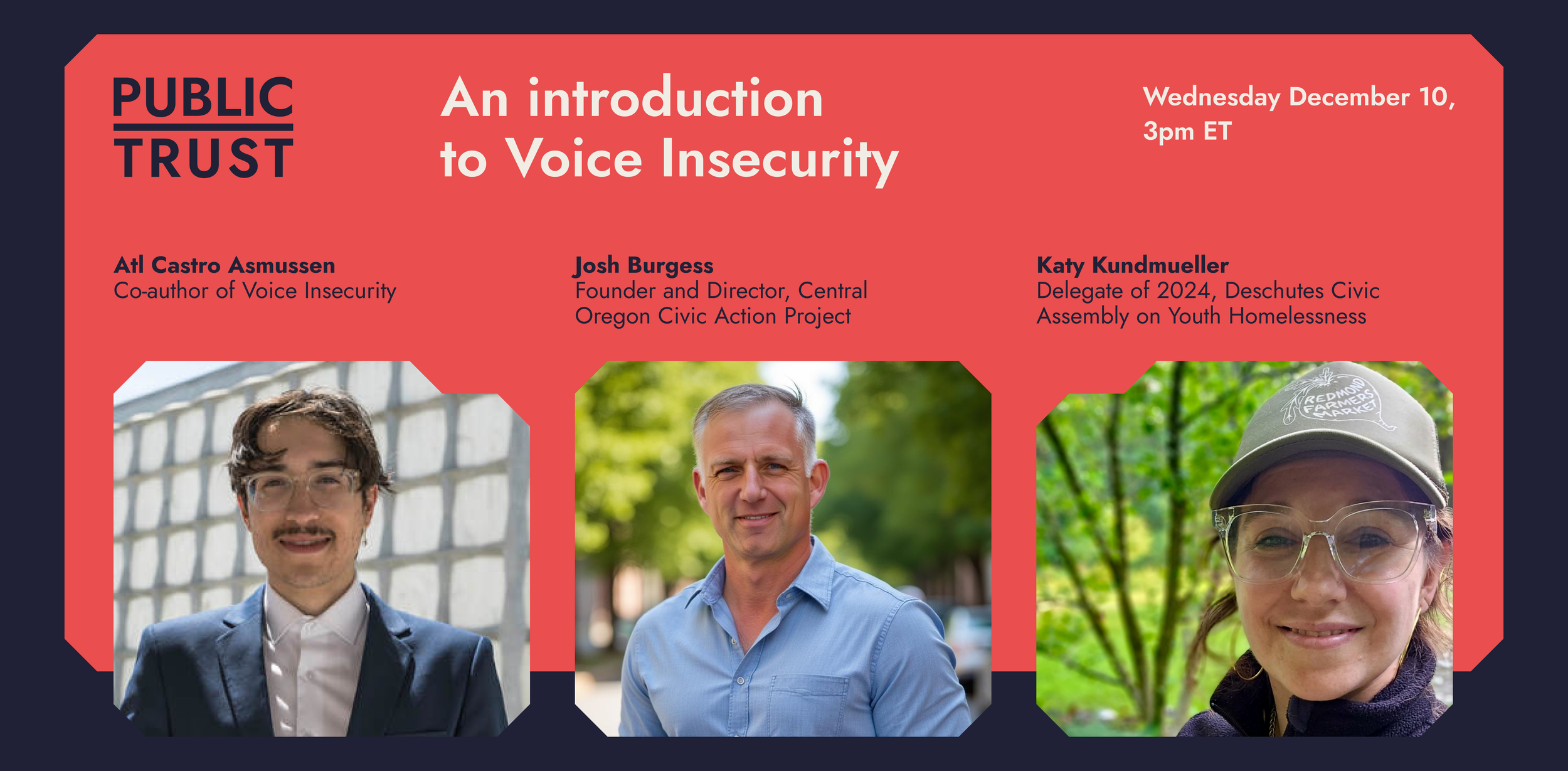
Public Trust - Webinar and Registration
FIDE - North America invites you to join us for a webinar on Wednesday, December 10th at 3:00 p.m.ET to discuss the concept of voice insecurity, introduced in a recent white paper by Marjan Ehsassi and Atl Castro Asmussen.
Read FIDE's Voice Insecurity paper here
Voice insecurity captures instances where your political voice is lost in the noise or never heard at all. It is not about whether you can speak, but rather that you feel your speech matters. We observe this phenomenon all too often in our society and politics. At FIDE - North America, we think citizens’ assemblies are part of the answer to addressing voice insecurity by giving regular people a voice in determining solutions to important and seemingly intractable issues.
Asmussen will introduce the concept, and then enter into conversation withJosh Burgess, the organizing force behind the Deschutes County Civic Assembly on Youth Homelessness and Katy Kundmueller, a delegate who served on that civic assembly. Cole Speidel will moderate the discussion. This webinar is open to the public, subject to registration.
Endorse our Theory of Change for Citizens’ Assemblies
After receiving more than 200 comments from 80 individuals and organizations across two conferences and multiple consultations, FIDE - North America has released a revised Theory of Change for Citizens’ Assemblies.
View the full theory of change document here.
Read more about the process behind the document here.
If you would like to endorse the theory of change, please email Cole Speidel with your organization’s logo.
Civic Lex Call for facilitators
Our friends at CivicLex are seeking a skilled facilitator to guide a multi-session Civic Assembly taking place in Lexington, Kentucky during March 2026.
The Civic Assembly will bring together a representative group of Lexington residents to learn about an issue, talk through different viewpoints, and develop recommendations for how local government can better serve the community. This project is part of CivicLex’s broader effort to strengthen public participation and trust in local decision-making.
CivicLex is engaging an independent facilitator who can create a fair, welcoming environment for participants and allow CivicLex staff to focus on design and logistics.
Happy holidays from FIDE — North America!
What a year it’s been!
As we close out 2025, we want to extend our best wishes to everyone who has supported and learned alongside FIDE – North America this year. Interest in our collective work is growing and your collaboration and enthusiasm have made it a truly remarkable year. As we look ahead to 2026, we’re excited to continue this work alongside our partners and collaborators. Thank you for being part of this expanding community of advocates, implementers, facilitators and researchers across North American cities, states and provinces. We wish you a wonderful holiday season and new year. We look forward to seeing you in 2026!
FIDE — North America Team