
A Theory of Change for Citizens’ Assemblies to Guide Our Democratic Reform Work in 2026
Citizens’ assemblies have increasingly moved from the margins of democratic innovation toward the center of serious co-governance conversations. As the field matures, however, a familiar challenge has come into sharper focus: we do not always agree on what success looks like, how to measure it, or how individual assemblies contribute to broader institutional reform.
In this newsletter, we want to highlight our effort to meet this moment: FIDE – North America’s Theory of Change for Citizens’ Assemblies. More than a blueprint or checklist, it is a shared framework—built collectively with practitioners, funders, researchers, and advocates—that identifies the key problems citizens’ assemblies are designed to address, the outcomes they can reasonably generate, and the conditions under which those outcomes are most likely to hold.
The Theory of Change itself is both a process and a product. Last year, FIDE – North America convened representatives from 18 organizations across the field. The resulting draft was then opened to public comment for two months and workshopped in Brussels at Democracy R&D and in Washington at the National Conference on Citizenship (NCOC). Incorporating more than 200 comments from over 80 contributors, the final document reflects not consensus on every point, but a good-faith effort to map where the field broadly aligns.
“It was a privilege to help shape this Theory of Change with FIDE and fellow practitioners,” said Matt Byrne, Senior Director of Deliberation at UnifyAmerica. “As deliberative democracy scales in the U.S., the field needs more than momentum—it needs shared standards and a clear rationale for our work. This document creates that common grounding, clarifying what we should be doing, why it matters, and how to grow with integrity and impact.”

Theory of change workshop, Democracy R&D 2025
“There is no playbook for how to innovate within our democratic process,” said Iain Walker, Executive Director of newDemocracy. “What FIDE have created leans into the idea that you don’t shed weight with one visit to the gym: instead, an ongoing commitment will build some new institutional muscle. To many people, democracy seems to have stopped being able to listen or make their lives better – so the democratic approach which can do this has the best chance of gaining widespread adoption.”
The Problem
The Theory of Change begins with a Problem Statement containing three interrelated problems many of us encounter frequently:
Governments are largely accountable only at election time;
Public decision-making fails to reflect the diversity of people’s lived experiences; and
Governments struggle to make progress on contentious public problems.
The Outcomes Produced by Citizens’ Assemblies
Citizens’ assemblies, when well designed and meaningfully connected to decision-making, intervene directly in these gaps.
Across seven key vectors, the Theory of Change traces how assemblies—commissioned by government, grounded in sortition, supported by learning and facilitation, and ending in actionable recommendations—can generate a set of short-term outcomes at 1) Individual, 2) Societal and 3) Institutional levels that could build into a long-term impact.
Note our emphasis on designing for legitimacy. Each outcome is accompanied not only by enabling conditions, but by risks that can undermine it—and practical ways to mitigate those risks. This reflects a shared recognition in the field: assemblies fail less often because of deliberation itself, and more often because of weak mandates, unclear government commitments, poor communication, or lack of follow-up.
1. Individual Empowerment & Voice
At its foundation, a citizens’ assembly is an experience of agency. Participants gain knowledge, skills, and confidence to engage with public problems and institutions. They come to see their voice as meaningful and their participation as consequential. Evidence shows that assemblies can strengthen civic identity and democratic capacity among those directly involved—especially when participants are supported, heard, and visibly connected to decision-makers.
2. Representation & Inclusion
Assemblies are designed to bring a broader range of lived experience into public decision-making than traditional participatory processes. When recruitment, support, and facilitation are done well, they can generate more inclusive and representative policymaking—both in who participates and whose perspectives shape outcomes. Demographic representation alone is insufficient; meaningful inclusion requires removing structural barriers, avoiding tokenism, and ensuring all participants have real voice.
3. Information Integrity
Citizens’ assemblies rely on access to trustworthy, balanced, and accessible information, both within the assembly and in terms of outward-facing communication to the public about the process. When evidence is curated independently, presented in multiple formats, and openly explained to the public, assemblies can counter distortion and build confidence in deliberative decision-making—even amid polarized or contested issues.
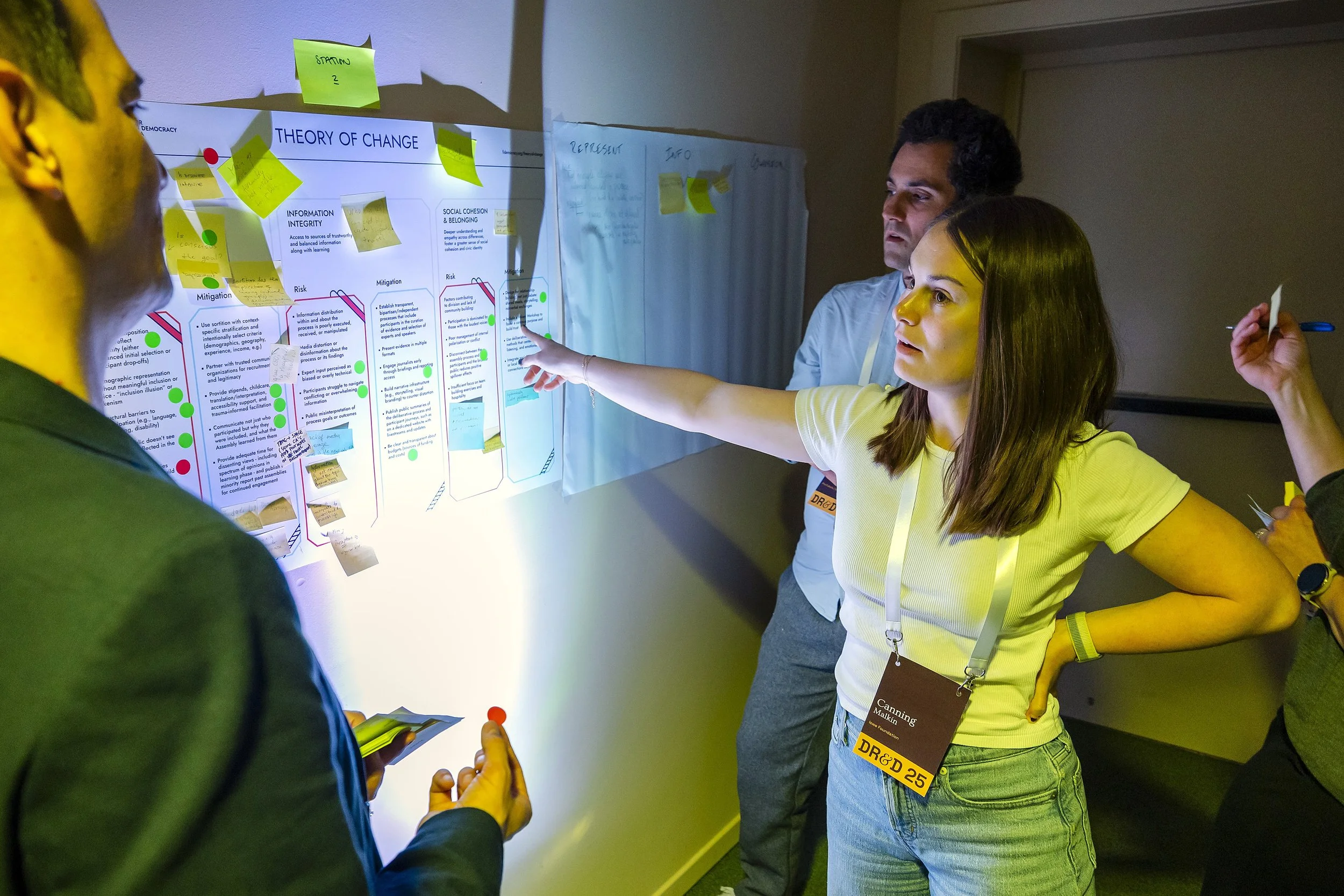
Theory of change workshop, Democracy R&D 2025
4. Social Cohesion & Belonging
Through structured deliberation, storytelling, and relationship-building, assemblies can foster understanding and empathy across differences. Participants often report a stronger sense of common civic identity and connection to others unlike themselves. While these effects are most immediate among assembly members, the Theory of Change recognizes their potential to ripple outward—especially when assemblies are visible, well-communicated, and connected to broader community life.
5. Legitimacy & Mutual Trust
Legitimacy is not assumed; it is built. Confidence in the integrity of the process—and in a credible government response—can increase trust between citizens and institutions. Clear mandates, transparent governance, public accountability, and visible follow-through are central here. We are careful to note that trust emerges conditionally and cumulatively, not automatically.
6. Policy Alignment & Impact
Assemblies are intended to do more than deliberate; they aim to inform and influence real policy. When topics are well chosen, mandates are clear, learning phases are robust, and recommendations are actionable, assemblies can produce policy proposals that reflect informed public judgment and rough consensus on community priorities. They should be aligned with policy cycles, feasibility, and mechanisms for tracking government response.
7. Responsive & Resilient Democratic Infrastructure
Finally, the Theory of Change looks beyond any single process. When citizens’ assemblies are repeated and/or institutionalized, they can contribute to more durable pathways for co-governance—shifting norms, incentives, and capacity within public institutions. This includes building government readiness to commission assemblies, creating opportunities for ongoing citizen engagement, and strengthening the democratic “muscle” needed to respond to future challenges.
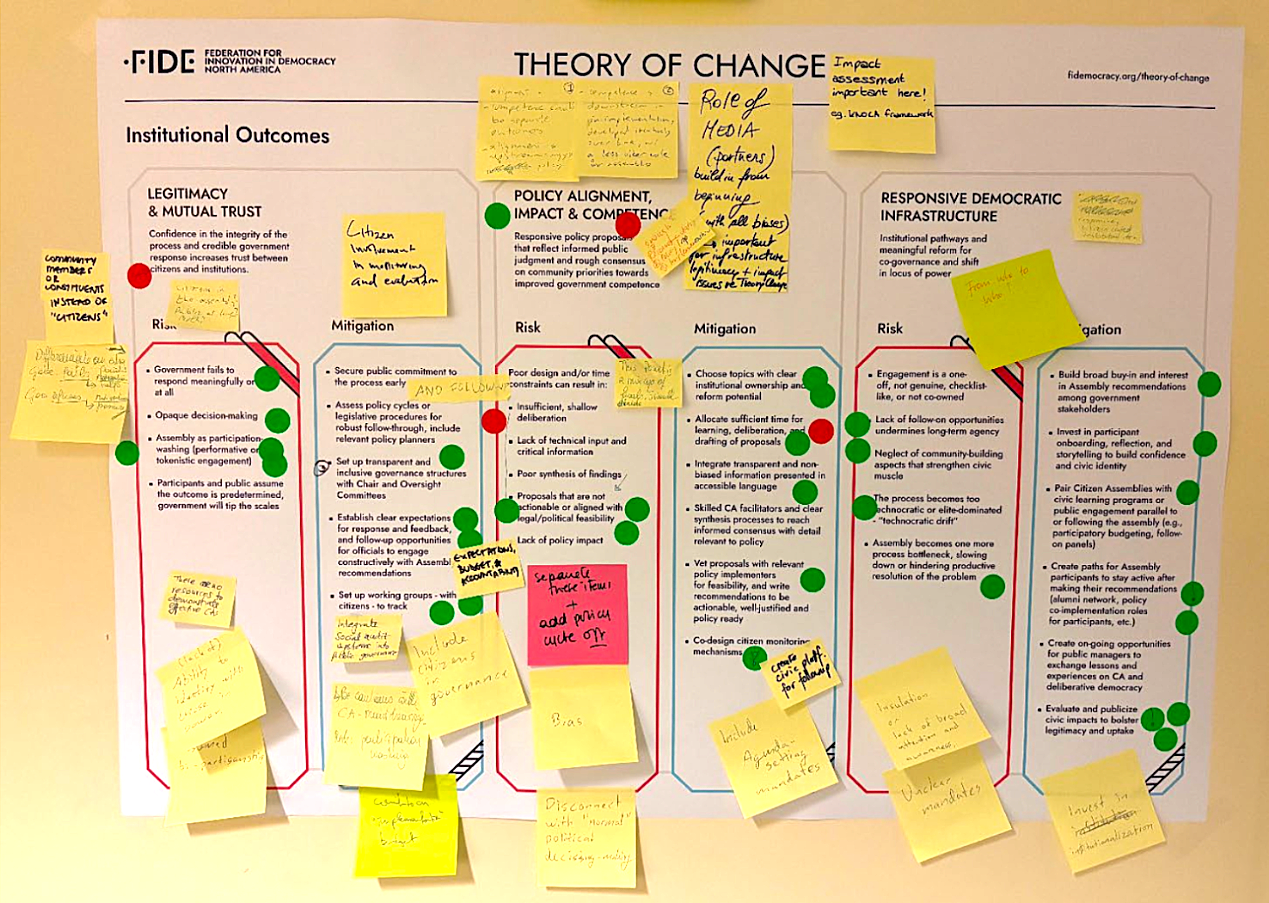
Feedback and markup from FIDE - North America's Theory of Change,Democracy R&D. Red stickers indicate disagreement or down votes, and green stickers indicate agreement or upvotes.
So what is this Theory of Change for?
For implementers, it offers a way to connect design decisions to intended outcomes and to plan evaluations, including but not limited to typical satisfaction surveys or attendance metrics. For funders, it provides a clearer picture of how assemblies fit into a broader civic ecosystem—and what kinds of impact are plausible at different time horizons. For researchers, it offers a structured set of hypotheses to test. For the field, it creates a shared language for discussing trade-offs, limits, and ambitions without overstating what any single process can deliver.
FIDE – North America is explicit that this is a living document. As evidence grows and practice evolves, the Theory of Change will be refined. In that sense, it mirrors the field itself: iterative, collaborative, and still in motion.
“Hundreds of Citizens' Assemblies are already taking place around the globe, however, they're sometimes seen as impotent one-offs,” said Canning Malkin, Research Coordinator for the Iswe Foundation. “This Theory of Change helps us strategize around short- and long-term goals that will lead to powerful systemic political change."
If citizens’ assemblies are to fulfill their promise as tools for democratic renewal, we will need not only good processes, but shared clarity about what we are trying to change together. We hope our process and this document can become a rallying point for discussion, friendly debate, and goal setting for our field.
To that end, we welcome additional feedback and questions at north.america@fidemocracy.org or Cole Speidel at cole@fidemocracy.org. If you would like to endorse this theory of change and add your organizations’ logo to the document and our website, please contact us.
RECENT EVENT: Wisdom of the Crowds with New America
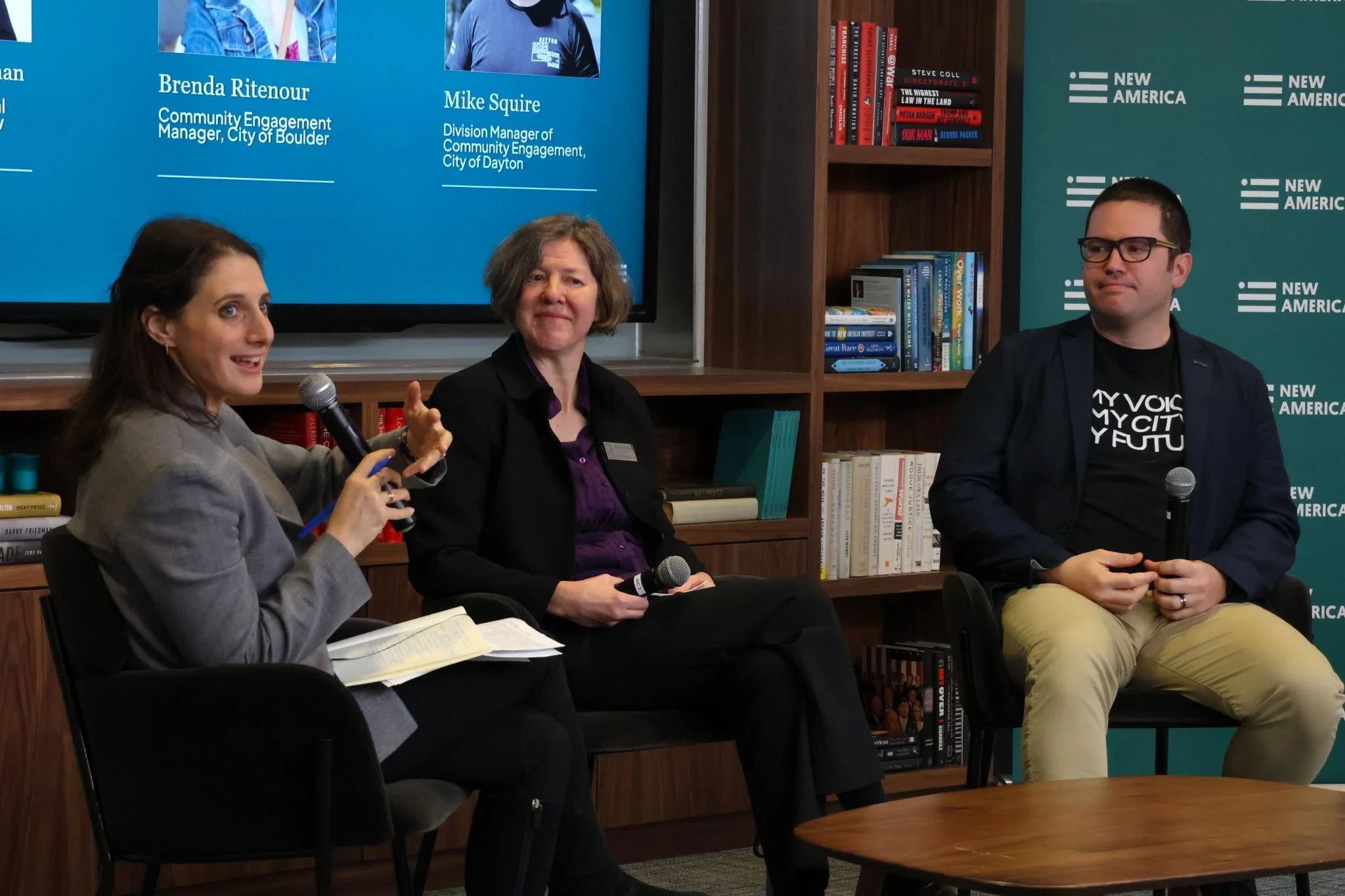
We recently took advantage of our gathered colleagues to host a panel at New America. The panel featured two city leaders: Brenda Ritenour, Neighborhood Engagement and Services Manager of the City of Boulder, and Mike Squire, Division Manager of Community Engagement for the City of Dayton. They spoke about the experience and potential for deliberation and trust-building in their communities, and what it means and what it takes for cities to lead and implement citizens’ assemblies.
From the conversation of New America’s Hollie Russon Gilman, Sarah Jacob, and FIDE - North America:
Dayton is currently facing a multi-million-dollar budget deficit and is working to piece together funding through external resources including leveraging philanthropic capital. Still, there was a shared understanding that engagement is an investment—one that pays dividends many times over. From a long-term planning perspective, early investment in community engagement helps lay the groundwork for more sustainable and effective outcomes.
You can view a recording of the event here.
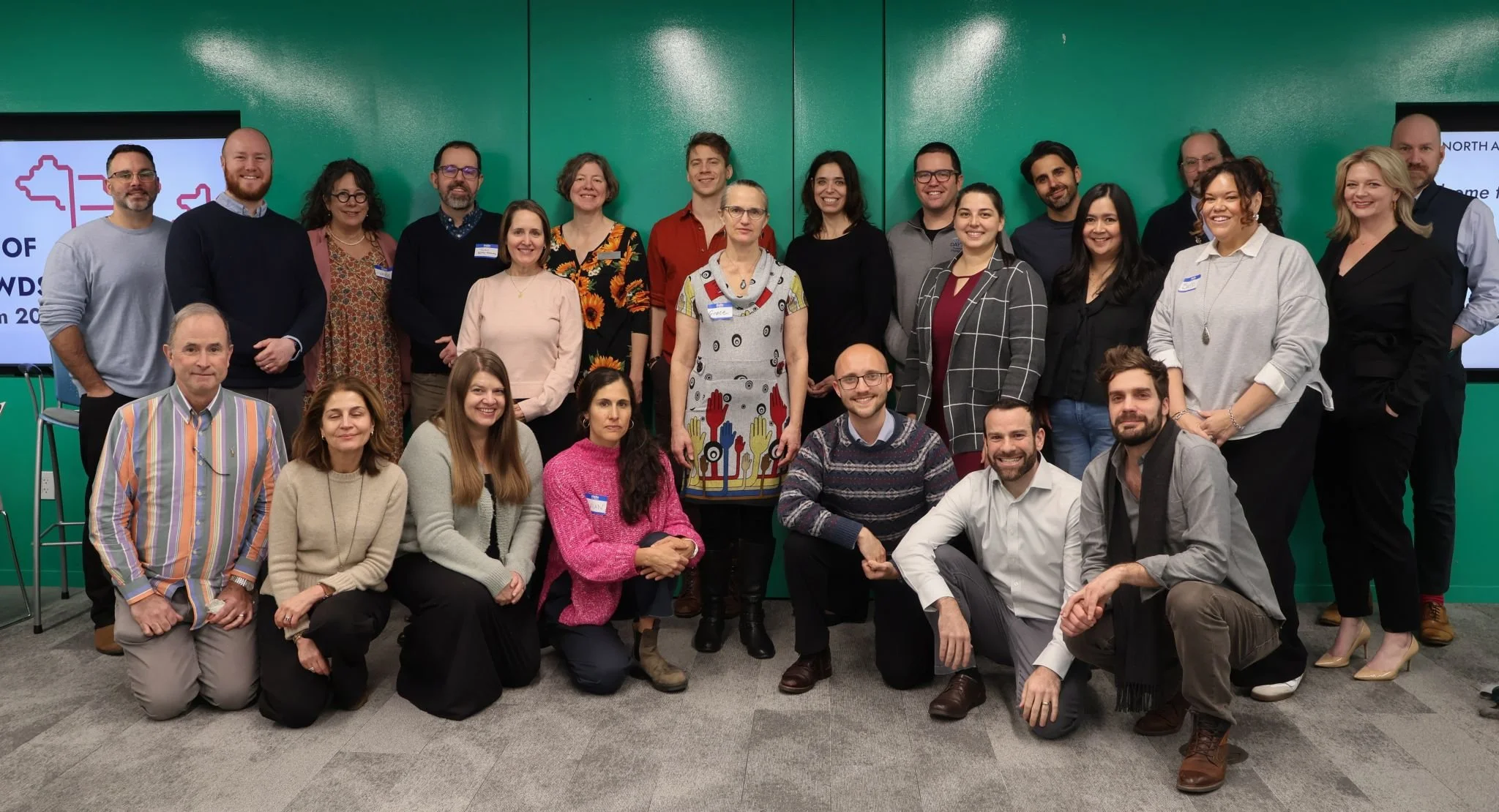
In January, we hosted more than 20 implementers and advocates for citizens’ assemblies for an in-person reflection of the citizens’ assemblies implemented last year and a strategy for our collective impact as a field in 2026. The day featured four ‘after-action reviews,’ deep dives into key decisions, moments, and insights from the teams behind the assemblies in Boulder, Fort Collins, Victoria Saanich, and the Canadian Youth Climate Assembly. We complemented these rich reflections with general discussion about our goals for the year and concrete areas for collaboration between our organizations.
We’re grateful to everyone who participated in that conversation, and for this exceptional community of practitioners and experts from across the US and Canada.
We will be sharing more outcomes from that gathering soon.
FIDE – North America is hiring: Part-Time Innovation Fellow (Washington, DC)
The Federation for Innovation in Democracy – North America (fidemocracy.org) is recruiting a part-time Innovation Fellow to support our work designing, training, and evaluating Citizens’ Assemblies across the U.S. and Canada.
Details:
• $20/hour
• ~8 hours/week
• Hybrid (weekly in-person check-in at Open Gov Hub, Washington, DC)
Who should apply:
Students or early-career professionals interested in democracy, civic engagement, government, comparative politics/federalism, or deliberative democracy.
What you’ll do:
This is a project-based fellowship. Fellows will own 1+ research/strategy projects (with clear deliverables) and present findings to the FIDE team. Topics may include government outreach capacity, procurement pathways, jurisdictional analysis, or mapping the democratic reform space. Occasional support for events/convenings.
To apply:
Send a brief cover letter, resume, and writing sample (≤ 3 pages) to Cole Speidel (cole@fidemocracy.org) with subject: “2026 FIDE Fellow Application – [Your Name]”